RV slide-out failures rarely start dramatically. The motor that dies tomorrow has been making a slightly different sound for three weeks, and the gear pack that strips itself has been showing a 1/4-inch corner gap for two months. Owners who catch the warning signs early pay one-fifth of what owners pay when the slide finally jams open or shut at a campground 200 miles from home.
This guide names the seven warning signs A1 RV Repair sees most often before a slide-out hits catastrophic failure. The signs apply across all three major slide systems: Schwintek in-wall, Lippert through-frame, and Power Gear hydraulic. The diagnostic order is also consistent, which is what makes the on-site call fast.
Sign 1: Grinding noise during slide-out travel
A grinding sound during slide-out travel is the highest-priority warning sign on the list. The grinding is metal-on-metal contact that should not be happening, usually at the gear pack teeth, the rack-and-pinion mechanism, or a misaligned motor mount. Every additional cycle accelerates the wear by shedding more metal into the mechanism, which damages neighboring components in turn.
The cost case for early intervention is brutal. A grinding slide caught at the first cycle costs $485 to $895 for a motor swap on a Schwintek system, or $585 to $1,100 for a Lippert gear pack inspection and rebuild. The same slide ignored for 8 to 12 cycles runs $2,400 to $3,500 because the gear pack, motor, and rail all need replacement together.
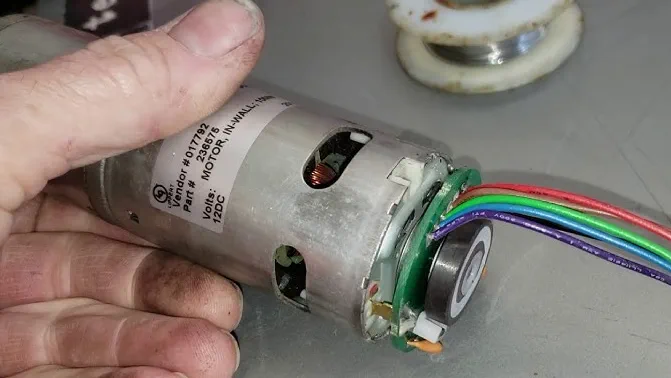
A1 RV Repair runs a current-draw diagnostic on grinding slides within the first 30 minutes of the call. The current measurement isolates whether the grind is mechanical (gear pack, rails) or electrical (motor windings, controller), which decides whether the fix is a part swap or a rebuild. Schwintek motor replacement and Lippert gear pack rebuild are the two most common repair pathways after a grind diagnosis.
Sign 2: Popping or clicking sounds at start or stop
Popping or clicking at the start or stop of a slide cycle is the second warning sign. The sound is usually a worn limit switch, a failing relay in the controller, or a binding fastener in the slide track. None of those are immediately catastrophic, but each one progresses to harder failures within 2 to 4 weeks of operation.
The diagnostic difference between popping and grinding matters. A pop is a single moment of contact or release; a grind is continuous contact across multiple seconds of travel. A pop at the start might be a relay finally engaging on a worn contact; a pop at the stop might be a limit switch with a worn cam. Both are repairable on the first service call, usually for $185 to $345.
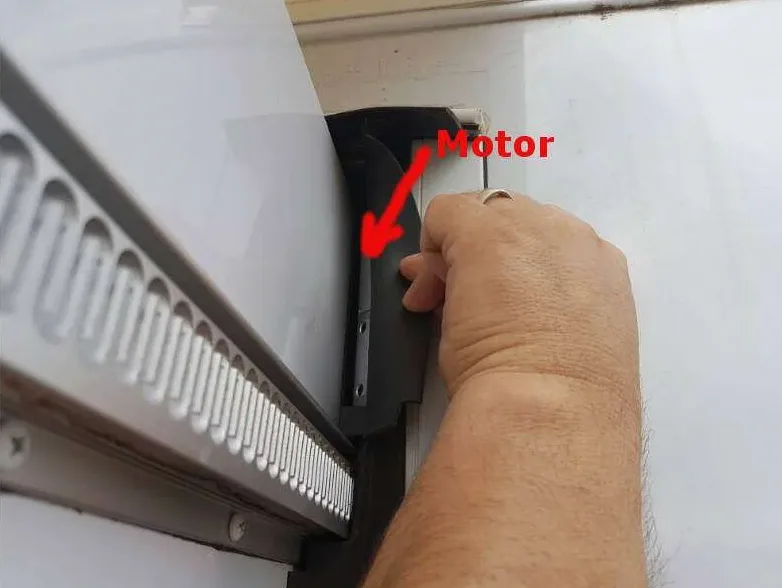
Schwintek in-wall slides have a specific popping pattern that indicates the top and bottom motors are coming out of sync. The pop happens because one motor reaches its target before the other and pulls against the misalignment. The fix is a sync re-time, which runs $185 to $345 if caught at the popping stage and $895 to $1,500 if the gear pack has been damaged by continued operation.
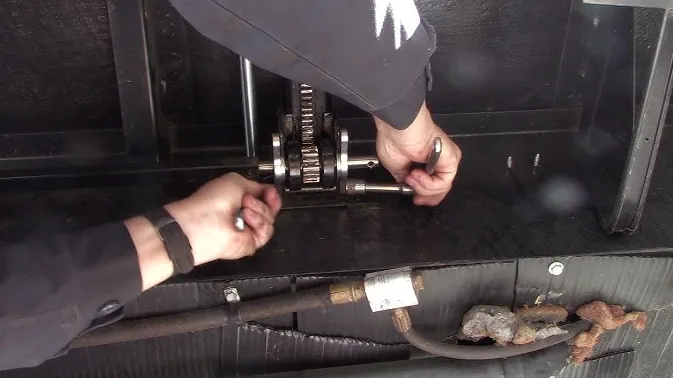
Lippert through-frame slides pop at the gear pack when a single tooth has worn enough to slip. The pop is the slip happening once per revolution. Lippert tech bulletins document the failure pattern and the diagnostic procedure. A1 RV Repair runs the bulletin-specified procedure on every popping Lippert slide call.
Sign 3: Visible corner gap when the slide is extended
A corner gap is a visible space between the slide wall and the coach wall when the slide is fully extended. The gap usually appears at one corner only and ranges from 1/4 inch to 2 inches. The visual is the clearest single indicator of an out-of-sync condition on a Schwintek or Lippert through-frame slide.
The sync problem starts mechanical and becomes electrical. A bind in the rail or worn lubrication causes one motor to lag the other by a fraction of a second per cycle; after 50 to 100 cycles, the lag accumulates into a visible gap. The controller cannot self-correct past a certain misalignment threshold, which is when the gap becomes permanent.
The fix depends on how long the gap has been ignored. Caught at first visibility, a sync re-time runs $185 to $345 and brings the slide back to true. Ignored for 6 to 12 months, the gap typically destroys the gear pack on one side because the controller keeps trying to compensate; that rebuild runs $1,200 to $2,000. Slide alignment service is the targeted fix when caught early.
Sign 4: Hydraulic fluid weeping at the slide cylinder
Hydraulic fluid leaking at a slide cylinder indicates a failed seal on a Power Gear or Lippert hydraulic slide system. The leak usually starts as a damp spot or staining on the floor underneath the slide and progresses to visible drops over a few days or weeks. Hydraulic fluid is typically reddish-brown and oily; if you see that color under the slide, this is your sign.
The failure mode is predictable. Hydraulic seals dry out, harden, and crack over 8 to 12 years of service. The crack lets fluid past the seal under operating pressure, which shows as the slow weep. Continued operation pushes more fluid out, and once the cylinder reservoir falls below operating volume, the slide gets stuck partly extended or refuses to retract at all.
The fix is a seal kit replacement, which A1 RV Repair handles on site for $385 to $725 depending on the cylinder location and access. Catching the leak at the first weep keeps the repair in that range. Letting it progress to a stuck slide that requires manual override and tow-recovery runs $1,800 to $3,200.
One specific failure to flag: weeping at the cylinder rod versus the cylinder body indicates different repair pathways. Rod weep is usually a $385 seal kit. Body weep often means cylinder replacement at $895 to $1,400. Hydraulic seal repair service handles both, with the on-site diagnostic deciding which path before any parts get ordered.
Sign 5: Sluggish travel taking over 60 seconds end-to-end
A healthy slide-out completes full extension or retraction in 25 to 45 seconds depending on system type and slide size. Schwintek in-wall slides run 25 to 30 seconds; Lippert through-frame slides run 35 to 45 seconds; hydraulic slides run 30 to 40 seconds. Travel time over 60 seconds is sign 5 and indicates either a weak motor, low battery voltage, mechanical drag, or controller fault.
The first thing to check is battery voltage. Slides demand high current at startup, and a battery below 12.4V resting voltage will drag travel time even on a healthy slide. Battery bank service covers the voltage issues; slide-out repair covers the mechanical and electrical issues on the slide side.
Past the voltage check, slow travel usually traces to worn lubrication on the slide rails or seals, a motor with degraded windings, or a controller that is current-limiting because of internal heat. A1 RV Repair runs the diagnostic in this order on every slow-slide call, and the diagnostic itself takes 30 to 60 minutes on site.
Sign 6: Blown fuses or tripped breakers when operating the slide
A slide that blows a fuse or trips a breaker during operation is drawing more current than the circuit was designed for. The overdraw traces to mechanical binding, a failing motor, a short in the wiring, or a controller fault that opens the motor circuit incorrectly. Continued reset attempts after a trip compound the damage and risk burning out motor windings.
The rule is one reset and stop. If the breaker holds after a single reset and the slide completes one cycle, schedule a diagnostic within the week. If the breaker trips a second time, the slide stays off until A1 RV Repair completes the on-site diagnostic. Continued reset cycles can destroy a motor that would otherwise be repairable.
The diagnostic is a current-draw measurement under load. A healthy Schwintek motor draws 8 to 12 amps under typical load; a failing motor draws 18 to 25 amps and trips the 20-amp breaker. Electrical diagnostics and emergency slide-out service run concurrent on every blown-fuse call.
Sign 7: Water staining at the interior slide ceiling or walls
Water staining at the interior slide ceiling or on the slide-out walls is the late warning sign on the list. The visible staining is the end stage of a sealant or slide topper failure that has been active for weeks or months. The underlying cause is usually a degraded slide seal, a torn slide topper, or a misaligned slide that lets water in at the top edge during rain.
The repair pathway depends on which failure is driving the leak. Slide topper replacement runs $625 to $1,150 and handles the topper-driven leaks. Seal replacement runs $285 to $545 and handles the perimeter seal failures. Slide alignment runs $185 to $345 and handles the misaligned-edge leaks.
The bigger concern is secondary water damage. A slide that has been leaking for weeks usually has wet substrate inside the wall or ceiling cavity. Water damage assessment on the same call catches the secondary damage before it requires a full sub-floor replacement at $2,200 to $4,800.
| Warning sign | Underlying failure | Repair caught early | Repair if ignored |
|---|---|---|---|
| Grinding noise | Gear pack wear | $485 - $895 | $2,400 - $3,500 |
| Popping or clicking | Limit switch / sync drift | $185 - $345 | $895 - $1,500 |
| Corner gap | Out-of-sync motors | $185 - $345 | $1,200 - $2,000 |
| Hydraulic fluid leak | Cylinder seal | $385 - $725 | $1,800 - $3,200 |
| Sluggish travel | Motor or controller wear | $295 - $595 | $985 - $1,800 |
| Blown fuse or breaker | Overcurrent / short | $225 - $495 | $1,500 - $2,800 |
| Water staining (ceiling) | Topper / seal failure | $285 - $1,150 | $3,500 - $9,000 (substrate) |
What should I do the moment I notice a warning sign?
The response order is consistent across all seven warning signs. Step one is stop running the slide immediately; do not test it again to confirm the symptom. Step two is photograph or video-record the symptom if it is visible, which speeds the on-site diagnostic and supports any insurance claim work.
Step three is check the basics that an owner can verify safely: battery voltage at the house bank, fuse and breaker condition, and any visible obstructions in the slide path. Step four is call A1 RV Repair for a same-day or 2 to 4 hour mobile diagnostic. The diagnostic identifies which repair pathway applies before any parts get ordered.
If the slide is stuck in the extended position and the coach cannot travel, manual override is the next step. Most Lippert and Schwintek systems have an override shaft or motor stub that accepts a drill or hand crank. Hydraulic systems have a pump bypass valve. A1 RV Repair walks owners through manual retraction over the phone at no charge in emergency cases.
How does A1 RV Repair handle slide-out diagnostics?
A1 RV Repair runs a standardized 4-step diagnostic on every slide-out call. Step one is a powered cycle test under observation, with the tech listening for the sounds and measuring travel time. Step two is a current-draw measurement under load to isolate mechanical versus electrical failure. Step three is a manual override test to verify the mechanism can move under hand power. Step four is a visual inspection of the gear pack, rails, seals, and topper.
The diagnostic completes in 30 to 60 minutes on site and produces a flat-rate repair quote before any parts get ordered. The $145 to $245 diagnostic fee applies toward the repair if the owner proceeds. Most owners proceed at the same dispatch because A1 RV Repair stocks Schwintek motors, Lippert gear packs, and common hydraulic seal kits on the service truck.
Pricing for the actual repair tracks the table above. Fix an RV slide-out vs replace it walks through the broader decision tree when multiple components fail together. Mobile RV repair cost in 2026 covers the underlying labor rate and trip fee structure that applies to every slide-out call.
Where does A1 RV Repair run mobile slide-out service?
A1 RV Repair runs same-day or 2 to 4 hour mobile slide-out dispatch across Florida, Texas, Idaho, Oklahoma, and Washington. Coverage includes coastal Florida from Jensen Beach through Fort Pierce, the Texas metros from Austin through Dallas, Idaho's Boise and Meridian, and the Washington Puget Sound corridor from Seattle south through Tacoma.
For related coverage, DIY vs hire a mobile RV technician covers why slide-out work is one of the five jobs that should never be DIY. Best time of year for RV roof repair covers the seasonal timing that affects slide-topper replacement. RV storm damage insurance claims covers the documentation that protects slide damage from named-storm events.