Progressive Dynamics, WFCO, Magnum, and Parallax converter diagnosis and replacement. Lithium-compatible profile upgrades on supported builds. Fluke voltage trace, breaker test, and full battery-side load test on every call. 2-3 hour install. Flat-rate quoted by phone before we dispatch.
Your converter is a two-way electrical brain. It takes 120V from shore power or a generator, converts it down to 12V, and charges your battery bank while running lights, water pumps, and slide-out motors. Most RVs run a Progressive Dynamics or WFCO converter - both solid units rated for 15+ years.
When it fails, you lose 12V power even plugged into shore power. Battery won't charge.
Slide won't move. Fridge on propane only. We see converter failures in Jayco, Forest River, and Winnebago rigs at about 8-12 years of age, especially if the unit sat unused for a season or took a power surge.
We had a Tiffin Motorhome customer on the Treasure Coast whose WFCO converter went silent after a lightning strike nearby. Shore power was live, but no 12V.
No lights. No hydraulic leveling.
We diagnosed the converter's internal breaker as blown and swapped a new WFCO unit in under 3 hours. Cost was $680 installed with labor.
Real scenario - and it happens more than people think in Florida's thunderstorm season. That's why we keep replacement units in the truck.
Signs your converter needs service:


Every call starts with a 30-minute diagnostic. We meter shore voltage at the converter input, AC breaker output, the converter's own DC output at the bus, and battery state-of-charge under load. Most "dead" converters turn out to be either an upstream tripped breaker, a marginal shore feed, or an internal converter fault - and we want to identify which before swapping anything.
For replacements, the standard sequence is: shore power off, photograph existing wiring at the converter's input/output bus, label every wire, dismount the old unit, transfer mounting hardware, set the new converter, terminate to the same bus locations, restore power, then verify output voltage and bulk-charge behavior with the battery bank under load. For lithium upgrade jobs, we configure the new converter's lithium profile and confirm the BMS sees correct charging current.
Converter replacement usually takes 2-4 hours on-site. Diagnostics alone take 45 minutes to an hour. If we're replacing the converter, add another 90 minutes for removal, wiring, breaker installation, and full system testing.
You can stay in your RV - we just need access to the converter box and battery compartment. In our covered metros core areas, we aim for 2-4 hour emergency response times. Outside core areas, we work through our nationwide partner network - turnaround depends on local shop availability, typically 3-7 days.
A Coachmen customer in Pensacola called us at 11 AM with a dead converter. We were there by 12:30 PM, diagnosed a blown internal breaker, and had a new WFCO installed and tested by 3 PM.
He drove out that evening. Nationwide, if you're in Montana or New Mexico, we'll connect you with a certified partner who handles it the same way we do - same flat-rate model, same standards.
Timeline breakdown:
All converter work carries a 90-day workmanship warranty. If we installed a new converter and it fails due to our wiring, breaker sizing, or install error within 90 days, we come back and fix it at no charge. Parts themselves carry the manufacturer warranty - typically 2-3 years for Progressive Dynamics or WFCO units.
If your converter fails again after 90 days but within the manufacturer window, we help you file a warranty claim. We don't hide behind fine print.
You get what you paid for, and we stand behind it. No hassle.
One customer had a WFCO converter we installed start dropping voltage output after 60 days. We diagnosed an internal capacitor failing - clearly a manufacturing defect, not our work.
We swapped the unit under the manufacturer's warranty at zero cost to him. That's how warranty works when you deal with people, not a corporate service center. We're here 15+ years later because we do the right thing the first time.
Warranty coverage:
Nationwide mobile coverage from a network of certified A1 RV Repair technicians, with same-day response in our core metros. Click any city for local response times and to book online.
Yes. The first thing we do is disconnect the negative battery terminal, which isolates the battery bank from the circuit without draining it.
Shore power stays connected to the RV's main panel throughout the swap, so hardwired systems that draw directly from shore - like your air conditioner on a dedicated breaker - are unaffected. During the work window, your fridge, slides, and 12V lights will be off because they run through the converter circuit, but the battery itself isn't being drawn down.
Once the new converter is seated, wired, and fuse connections confirmed, we reconnect the negative terminal and test output voltage at the battery terminals to verify the unit is charging correctly before we close up. If your battery was already low coming in, we'll let you know - a depleted battery can take 30-60 minutes to show a stable reading, and we won't leave until the numbers look right.
Jaycos typically use a 55-60 amp converter, and replacement runs $500-$520 installed whether we put in a Progressive Dynamics or WFCO unit. That flat rate covers the old unit pull, wiring transfer, new converter install, and a load test to confirm the output is hitting 13.4-13.8V at the battery terminals before we leave.
The variance between those two brands comes down to parts availability the day of your job - both perform comparably in a residential-style converter application. If we open the converter bay and find corroded buss bars or melted wiring from a previous overload, that's a separate line item we call you about before touching anything. We quote flat-rate by phone with your year and model, so the number on the invoice matches what you heard upfront.
Yes - lithium batteries charge at a different voltage profile than lead-acid, and using a converter designed for lead-acid can shorten the life of your lithium bank or trip the battery's built-in protection circuit repeatedly. A lithium-compatible converter like the WFCO 80-amp unit ramps the charge rate down smoothly as the battery approaches full rather than holding a float voltage that lithium cells don't want.
On a job, we verify the converter's output profile with a meter before we call the install done - it's not enough to just bolt in the new unit. If you're upgrading to Battle Born or Victron lithium, we'd recommend stepping up to the 80-amp WFCO even if your current setup runs a 55-amp, because lithium charges faster and you want the headroom to take advantage of that without pushing the converter to its limit on every cycle.
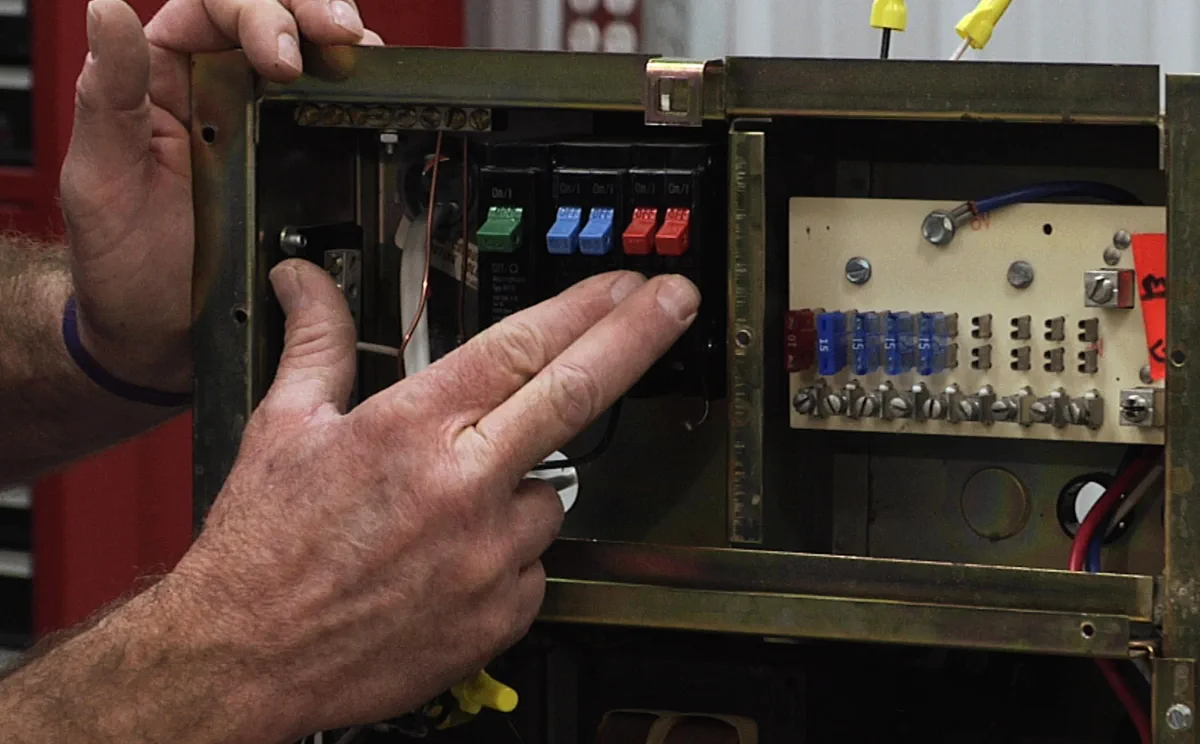
Resetting a tripped breaker on the converter is a reasonable DIY step - check the breaker panel, reset it, and see if output voltage comes back on shore power. Beyond that, the work moves into territory where mistakes are expensive and occasionally dangerous.
Inside a converter you're dealing with high-voltage AC input, heat-producing rectifier components, and circuit boards where a solder bridge in the wrong place can cause a thermal runaway or take out downstream 12V devices throughout the rig. We've seen a $200 board repair turn into a $1,200 replacement because a previous attempt pushed current through the wrong path. If your converter won't power on, outputs zero or erratic DC voltage, or runs hot and shuts off under light load, those are diagnostic jobs - bring in a tech who can trace the fault before touching anything.
In our our covered metros core service areas, we target a 2-4 hour response for emergency calls - a dead converter means no battery charging, no 12V lighting, and refrigerators that switch to propane-only mode, so we treat it as urgent. When we arrive, we run a quick voltage test at the battery and converter output terminals to confirm the converter is the failure point before pulling anything apart, then we either repair or swap the unit on-site depending on what we find. Outside our core areas, we dispatch through our nationwide certified-tech partner network, and availability varies by region - call us and we'll give you a real ETA based on who's actually closest to your location, not a generic estimate.
A converter only works when you're plugged into shore power, so upgrading it does nothing for off-grid time. What actually extends a boondocking stay is adding battery capacity - either more AGM lead-acid banks or a switch to lithium, which gives you usable capacity closer to 100% versus the 50% you get from lead-acid before you risk damage.
Pair that with an inverter sized to your 120V loads (microwave, CPAP, outlets) and you have a real off-grid system. Where a converter upgrade does fit into that picture is if your current unit is undersized to properly recharge a larger battery bank when you do hook up to shore power - a weak converter will take twice as long to recover your batteries after a night of heavy use. We can assess all three pieces together and quote a bundled install so you're not paying separate trip charges for each component.
The breaker is always the first thing we check, because it fails more often than the converter itself and costs a fraction of the price to swap. If the breaker trips under load but resets cleanly and the converter puts out 13.4-13.8V on shore power afterward, a new breaker at $120 closes the job.
If the breaker looks fine or a new one still trips immediately, that points to an internal fault in the converter - a failed transformer, bad capacitor, or shorted rectifier diode - and at that point replacement makes more sense than chasing individual components. We carry common converter units on the truck, so if the diagnosis points to a full swap we can usually complete it the same visit. You only get quoted for what the diagnosis actually finds.
Lightning damage voids manufacturer warranties almost universally - it falls under "act of God" exclusions that no converter brand covers, regardless of how the unit was installed or how new it is. Your best path is your RV insurance policy, which typically covers electrical damage from lightning strikes under comprehensive coverage.
We can come out, diagnose which components took the hit, and write a detailed repair estimate your adjuster can work from. Lightning rarely stops at the converter - the same surge often takes out the inverter, charge controller, and any 12V circuit boards downstream, so the inspection covers the full electrical system, not just the converter itself.
A converter replacement runs $500-$1,200 depending on amp capacity and whether the distribution panel needs work alongside it. File the claim first, then call us to schedule the diagnostic.
Same flat-rate pricing in every city. Same RVIA-certified mobile crew. Same parts-on-truck approach so most calls finish in one visit.
Often booked together with this repair. Same crew, same flat-rate, same on-site visit.