RV roof failure follows a predictable arc that has almost nothing to do with the roof material itself. The membrane lasts as long as the sealant around its penetrations does. A TPO roof rated for 15 years dies at year 8 when the sealant at the AC and front cap releases in year 6 and the leak goes undetected for 18 months.
That arc is also why "what roof does my coach have" is the second most important question on every A1 RV Repair roof call. The first is "when was the last full perimeter reseal." Owners who can answer both honestly almost always have a roof in the upper third of expected lifespan. Owners who cannot answer either are usually at the wrong end of the bell curve.
How long does each RV roof material last?
The 2026 lifespan ranges for each common RV roof material assume annual sealant inspection and a full perimeter reseal at the recommended cadence. Numbers below match what A1 RV Repair tracks across roughly 12,000 service tickets, with the caveat that climate, storage, and maintenance discipline each move the number by 2 to 5 years in either direction.
TPO (thermoplastic polyolefin) is the most common new-coach roof and runs 12 to 15 years on a maintained schedule. EPDM (ethylene propylene diene monomer) rubber runs 15 to 20 years and was the dominant membrane on coaches built before 2015. Fiberglass runs 20 to 25 years and is mostly a high-end Class A material; aluminum runs 25 to 30 or more years and is dominant on vintage coaches and a few specialty builders.
The headline numbers are deceptive without the maintenance assumption. A neglected TPO roof releases sealant at year 4 and rots substrate by year 7. A maintained TPO roof with every-4-year reseal lasts the full 15 years. Same material, almost double the life span; the difference is the reseal cycle, not the membrane.
| Roof material | Typical lifespan | Full reseal interval | Annual inspection cost | Replacement cost (30-ft) |
|---|---|---|---|---|
| TPO membrane | 12 - 15 years | 4 - 5 years | $145 - $245 | $5,500 - $8,500 |
| EPDM rubber | 15 - 20 years | 4 - 5 years | $145 - $245 | $6,000 - $9,000 |
| Fiberglass | 20 - 25 years | 5 - 7 years | $165 - $285 | $9,000 - $12,000 |
| Aluminum | 25 - 30+ years | 6 - 8 years | $165 - $285 | $7,500 - $10,500 |
| Liquid roof coating (over old TPO/EPDM) | +5 - 7 years over base | 3 - 4 years | $165 - $285 | N/A (overlay) |
What is the maintenance timeline for a TPO roof?
TPO is the most common new-coach roof material in 2026 and follows the tightest maintenance cadence. Year 1 starts with a baseline inspection, photo documentation, and a Dicor sealant audit at every penetration. Year 2 and year 3 are annual visual inspections that catch isolated failures. Year 4 is the first full perimeter reseal; this is the single most important service in the entire TPO lifespan.
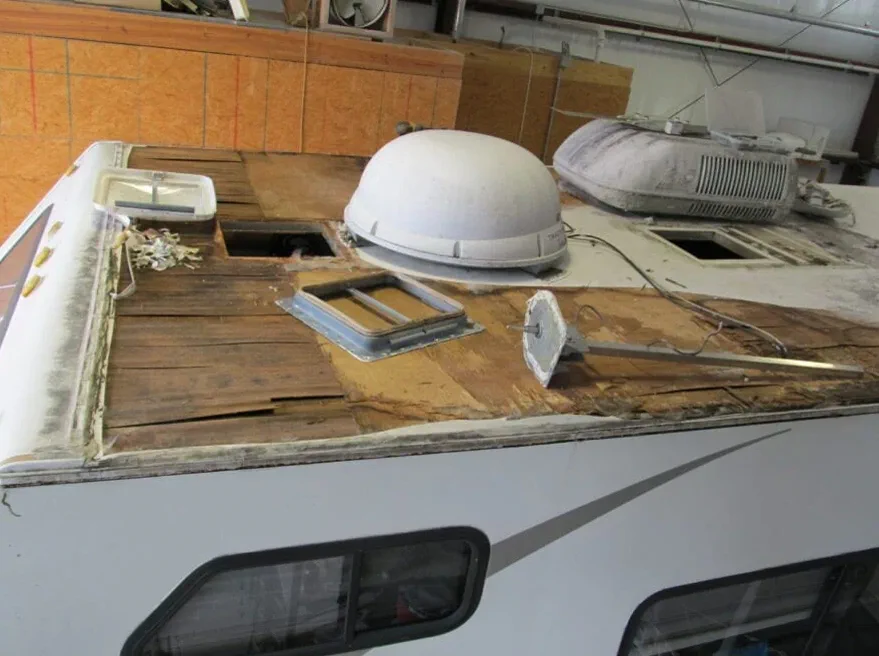
The reason year 4 matters is that TPO sealant cures hard for the first 2 years, holds well through year 3, and starts releasing internally in year 4. By year 5, the released sealant lets water under the membrane at low spots, and the substrate underneath begins to rot. The 4-year reseal is the intervention that breaks that arc.
Years 5 through 8 follow the same annual-inspection rhythm with a full reseal at year 8 to 9. Coastal coaches in Vero Beach, Stuart, or Fort Pierce tighten the cycle to every 3 years because UV and salt accelerate sealant breakdown. EPA UV index data for southern Florida runs 11+ for most of the year, which is the highest stress level for any RV roof material.
Years 12 through 15 are typically when the TPO membrane itself reaches end of life. Owners who hit the maintenance cadence cleanly often push the replacement decision to year 18 or 20. TPO and EPDM replacement service runs $5,500 to $8,500 on a 30-foot coach, with the timing window of fall and early spring producing the best cure conditions per Dicor product specifications.
What is the maintenance timeline for an EPDM rubber roof?
EPDM rubber roofs follow a slightly looser cadence than TPO because the material handles UV better and flexes more readily under temperature swings. The recommended schedule is still annual inspection, with the first full reseal at year 4 to 5 and subsequent reseals every 4 to 5 years thereafter. EPDM is the dominant membrane on coaches built between 2000 and 2015 and on a lot of current production trailers.
The material's lifespan advantage is real but conditional. Maintained EPDM hits 18 to 20 years routinely; neglected EPDM dies at the same 8 to 10 years as neglected TPO. The EPDM Roofing Association publishes the material-care guidance that A1 RV Repair follows on every EPDM service call.
One EPDM-specific concern is the heat absorption. Black EPDM runs interior temperatures 10 to 15 degrees Fahrenheit higher than white TPO under direct sun, which puts more load on the AC system and shortens compressor life. Coaches in Austin, Dallas, or any Sun Belt metro often install reflective coatings or sun-shade structures to mitigate that load.
What is the maintenance timeline for a fiberglass roof?
Fiberglass roofs are the longest-lasting common RV roof material and the lowest-touch on the maintenance side. Annual inspection still applies, but the full reseal interval stretches to 5 to 7 years because fiberglass is rigid and the sealant joints flex less than on membrane roofs. The lifespan ceiling at 20 to 25 years assumes the gel coat is maintained, which is the fiberglass-specific maintenance item.
Gel coat protects the underlying fiberglass laminate from UV. Faded or oxidized gel coat is the most common fiberglass roof issue, and it shows up at years 8 to 12 on coastal coaches and years 12 to 15 on dry-climate rigs. The fix is a fiberglass-rated polish and wax cycle every 2 to 3 years, which restores gel coat protection and adds 5 to 10 years to coach lifespan.
Fiberglass also has a different failure mode at end of life. TPO and EPDM fail by membrane breakdown and sealant release; fiberglass fails by delamination at the seam between the roof and the cap, or by stress cracks at the AC, vents, and slide-out roof edges. Fiberglass roof repair service handles both modes with a different sealant kit than TPO and EPDM work.
How does climate change the maintenance cadence?
Climate adjusts the standard cadence in three directions: UV stress, freeze cycles, and moisture exposure. Each variable moves the reseal interval by 6 to 18 months in one direction or the other. A1 RV Repair sets the maintenance cadence based on storage location and use pattern, not just on the calendar.
UV stress hits Florida, Texas, and Arizona coaches hardest. National Weather Service UV data documents UV index values above 11 for most of the year in southern Florida and the Gulf Coast. Coaches in Port St. Lucie, Miami, or Key West tighten the TPO reseal to every 3 years and the EPDM reseal to every 4 years.
Freeze cycles hit Idaho, Washington Cascades, and the Texas Panhandle hardest. Repeated freeze and thaw cycles stress sealant joints and can crack rigid fiberglass at points where the substrate moves more than the laminate. Coaches in Boise, Meridian, or the Cascade foothills get an extra fall inspection to catch joint failure before winter.
Moisture is the Pacific Northwest variable. Year-round damp conditions promote moss and algae growth on every RV roof material, which traps moisture against the sealant and accelerates breakdown. Coaches in Seattle, Tacoma, or the Olympic Peninsula need a soft-brush wash every spring with an algae-rated cleaner.
| Climate zone | UV factor | Adjusted reseal interval | Extra maintenance step |
|---|---|---|---|
| Coastal Florida / Gulf Coast | Very high (UV 11+) | -1 to -2 years tighter | Annual gel-coat or membrane wash |
| Texas Sun Belt | High (UV 9-11) | -1 year tighter | Hail-event inspection per storm |
| Idaho / Mountain West | Moderate (UV 6-9) | Standard cadence | Fall freeze-prep inspection |
| Pacific Northwest | Low (UV 4-7) | Standard cadence | Annual moss and algae wash |
| Oklahoma / Central Plains | Moderate-high (UV 7-10) | -6 months on TPO/EPDM | Tornado and hail-event inspection |
What are the signs an RV roof is at end of life?
Five signs indicate end-of-life on an RV roof, and any two together usually mean replacement rather than another reseal. Sign one is chronic chalking that returns within 6 months of cleaning; the membrane has lost its protective coating and is breaking down from the surface in.
Sign two is sealant that releases every season instead of every 4 to 5 years. The substrate underneath has likely moved enough that no new sealant will hold, and the rot may already be invisible. Sign three is soft spots in the substrate underfoot; this is past the warning stage and into active damage.
Sign four is visible delamination at the roof-to-cap seam, around the AC, or at the slide-out roof edge. Sign five is a pattern of small leaks across multiple penetrations rather than one isolated failure. The pattern indicates systemic sealant degradation, which a single reseal cannot reverse.
How does A1 RV Repair set the inspection schedule?
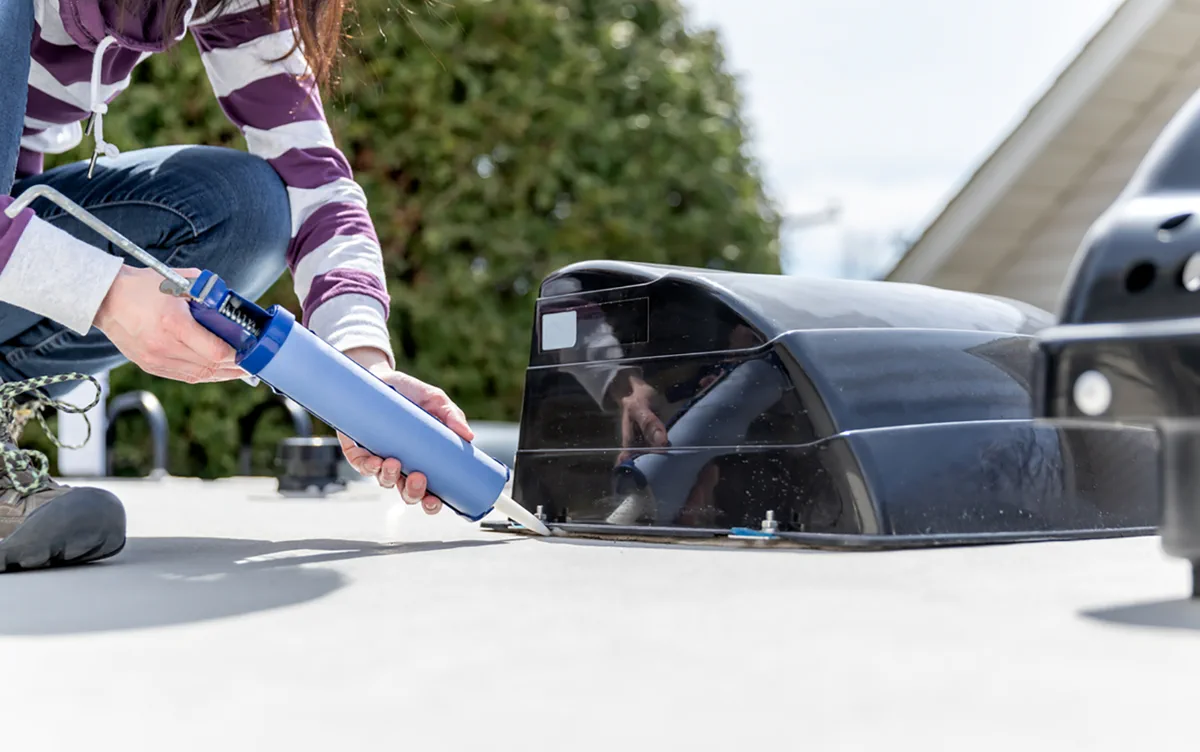
The standard A1 RV Repair maintenance schedule pairs a spring inspection with a fall sealant inventory. Spring catches winter freeze damage on northern coaches; fall catches summer UV damage on southern coaches. The same-truck visit costs $145 to $245 and replaces the need for any single-issue dispatch through the year on a well-maintained roof.
The inspection itself covers seven checkpoints. Lap sealant condition at every penetration. Substrate sounding for soft spots. AC, vent, and antenna fastener torque. Slide-out roof edge for delamination. Roof-to-cap seam at front and rear. Drip edge along the perimeter. Any owner-flagged areas from the prior visit.
Findings go into a prioritized work list with cost estimates for each item. Leak survey work runs concurrent on any coach with active interior staining. Roof leak repair handles the immediate fix; the inspection schedule prevents the next one. For seasonal timing, best time of year for RV roof repair walks through the temperature and humidity windows that produce the best sealant cure.
What does A1 RV Repair charge for the full lifecycle?
A 15-year TPO roof lifecycle on the A1 RV Repair maintenance schedule costs $4,200 to $6,800 in total maintenance spend, against a $5,500 to $8,500 replacement cost at year 15. The total ownership cost is roughly two-thirds the unmaintained replacement, with the added benefit that maintained coaches retain 15 to 25 percent more resale value at trade-in.
The math is even stronger on EPDM and fiberglass. A maintained EPDM roof at 18 to 20 years of life costs $4,800 to $7,500 in maintenance against a $6,000 to $9,000 replacement. A maintained fiberglass roof at 22 to 25 years costs $5,500 to $8,500 in maintenance against a $9,000 to $12,000 replacement. Both pencil heavily in favor of the maintenance cadence over the replacement cycle.
For related coverage, RV roof types compared walks through the material-by-material identification and decision criteria for replacement choice. Storm damage insurance claims covers the cause-of-loss documentation that protects against catastrophic single-event damage. Mobile RV repair cost in 2026 covers the underlying labor rate structure for all of the roof work above.