What does an RV roof leak actually do to the inside?
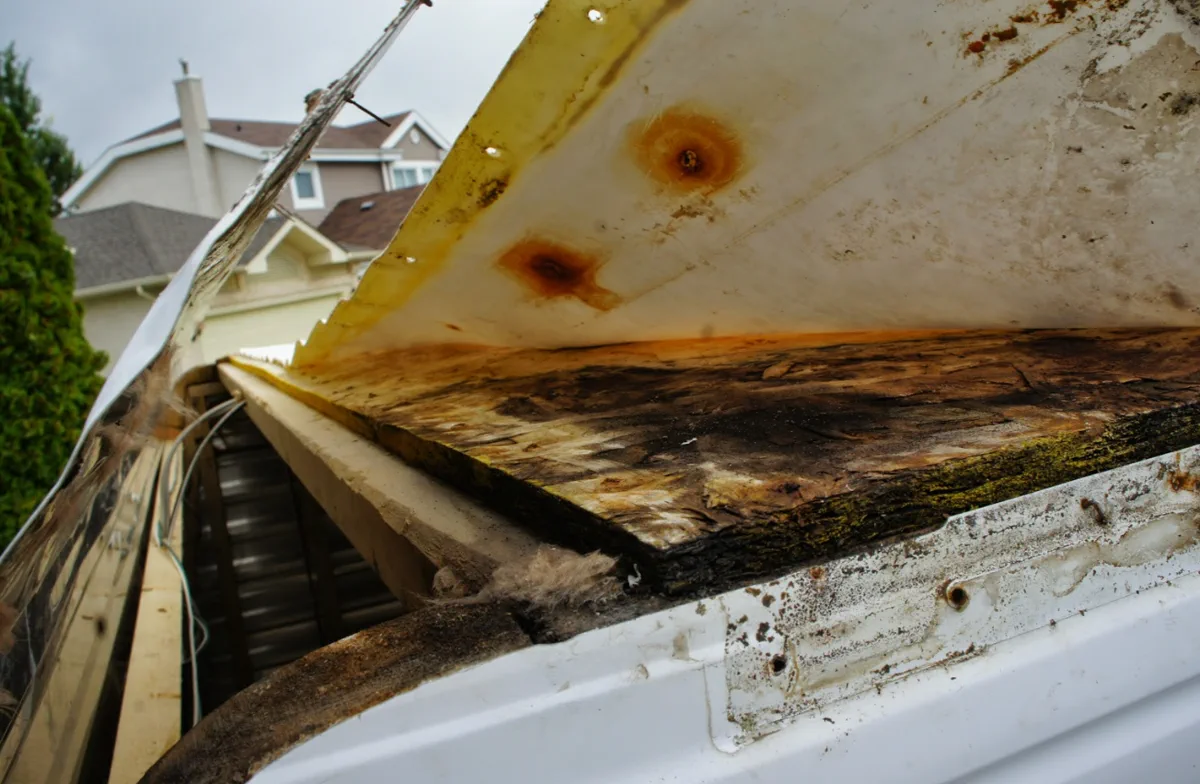
Water inside an RV laminate doesn't just sit in one spot. It spreads between layers - the fiberglass shell, the plywood substrate, the insulation. Within weeks, you've got soft spots, mold, structural rot.
The laminate delaminates. Once that happens, you're not patching anymore - you're replacing roof sections, which runs $3,000 to $8,000 per linear foot on a 32-footer.
We catch leaks early by pressure-testing with soapy water, thermal imaging, and 15 years of knowing where water hides. Most leaks come from failed Dicor lap sealant around vents, AC units, and seams.
TPO and EPDM membranes crack from UV and thermal stress. Fiberglass roofs split at stress points. The sooner you call, the cheaper the fix.
We serviced a 2019 Jayco Pinnacle last month - owner noticed a damp smell in the bedroom but no visible staining yet. Turned out the AC gasket on the roof had separated, letting moisture creep in between the Coleman-Mach unit and the fiberglass.
We resealed it with Dicor and ran a moisture meter through the wall cavity. Caught it before the plywood got soft.
Two hours, $575. That same leak found six months later would've meant replacing 8 feet of roof.
That's why early diagnosis matters. We'll walk you through what we find before we start work.
Signs of roof water intrusion:
- Damp smell in bedroom or front cabin
- Soft spots or spongy areas on interior ceiling
- Discoloration or staining on interior walls near roof
- Mold or mildew smell after rain
- Condensation that won't dry
- Cracked or missing Dicor sealant around vents
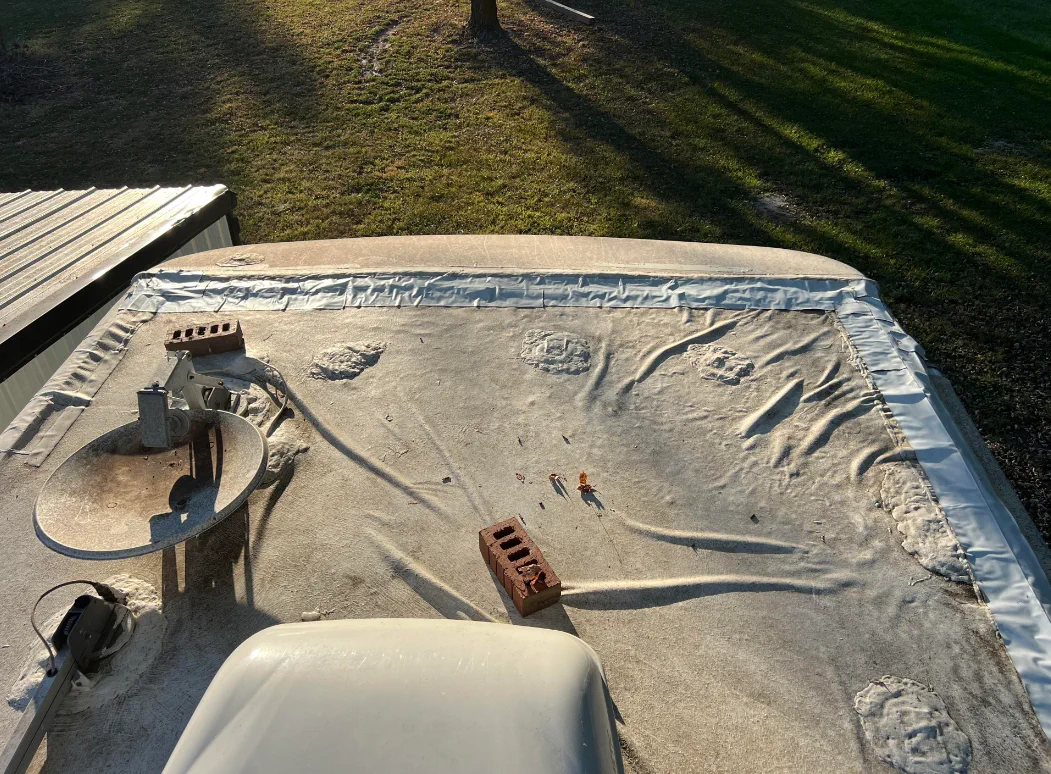
Signs you have a roof leak that needs immediate attention
Four patterns cover almost every leak call we run. Catch any of these inside the first month and you save thousands in laminate repair costs.
1. Brown stains around vents or AC
Water has been entering through a vent flange, AC gasket, or skylight perimeter for weeks. The Dicor seal has shrunk back and water is now reaching the Lauan ceiling panel. Reseal job, $245-$485 if you catch it now.
2. Soft or spongy ceiling underfoot
You walked the roof and it gave under you, or the interior ceiling flexes when you press up on it. Decking is saturated. We pull the membrane, dry the cavity, and replace decking before any reseal goes down.
3. Musty smell after a rainstorm
You don't see staining yet but the rig smells damp every time it rains. Hidden leak somewhere along a slide-room edge or sidewall seam. Our moisture meter finds it without cutting.
4. Cracked or chalky Dicor on inspection
You went up to look and the lap sealant is fissured, lifting, or chalky white. Reseal now before the next storm - Dicor that looks like that won't hold the next rain event.
How do we find and fix a roof leak?
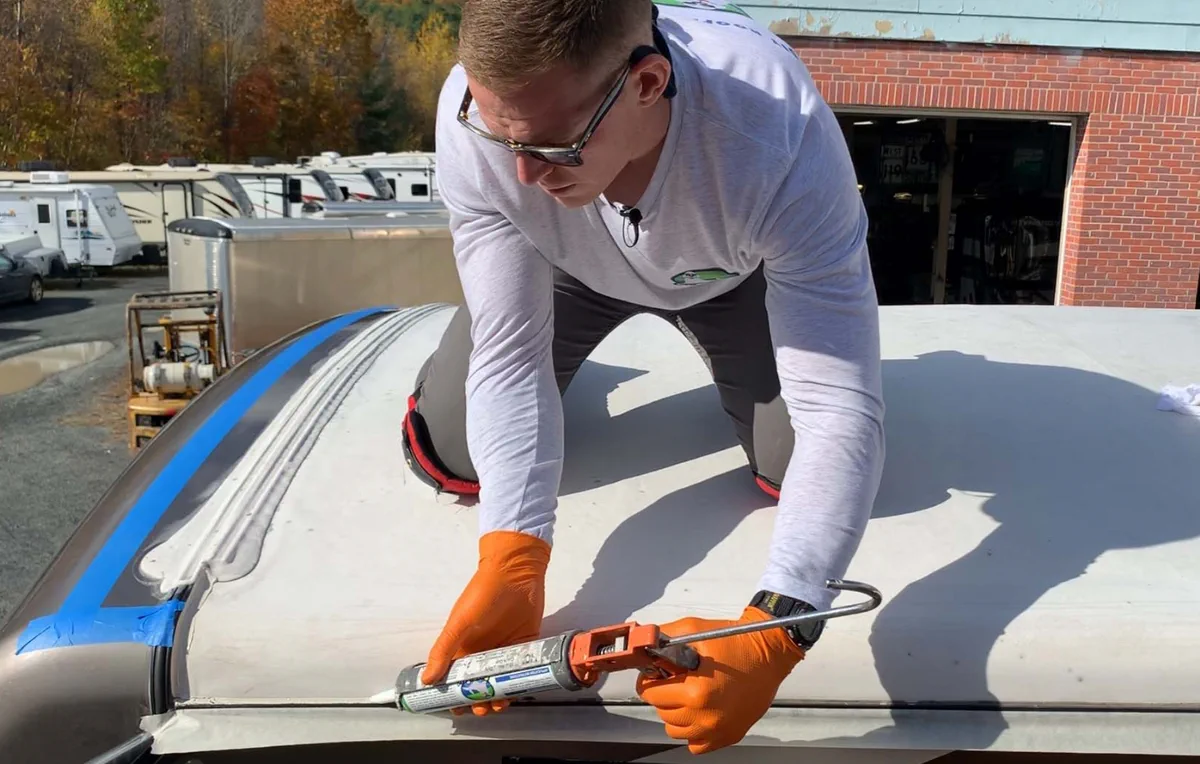
Finding a leak means isolating the source - not just treating symptoms. We use three methods: visual inspection with a flashlight for obvious gaps or membrane separation; soapy water spray under regulated pressure to bubble at the entry point; and a Tramex moisture meter combined with IR thermal imaging to map saturation behind the surface. The combination is what makes the diagnosis actually accurate - any one method by itself misses the harder leaks. Once we have the entry point, we strip the failed material to clean substrate, dry the area, and bond fresh material with the right primer for the membrane type.
- Visual inspection with high-output flashlight at every seam, vent, and penetration
- Pressure test with soapy water under controlled flow rate to bubble at active entry points
- Tramex moisture meter scan across full roof and inside ceiling panels
- IR thermal imaging to map cold spots from saturated insulation
- Pin-meter depth probe at suspect zones to confirm substrate condition
- Marked-up photo log delivered with the repair quote
What's the real cost breakdown for roof leak repair?
Price depends on what broke and how big the repair is. Vent gasket reseals (Dometic or Coleman-Mach AC units, roof vents, plumbing stacks) run $245-$485 each. Dicor lap sealant replacement along seams or around openings costs $245-$485 for a spot reseal or $785-$1,250 for a full strip-and-reseal of every joint on a 32-foot rig.
EPDM or TPO patches under 2 sq ft run $385-$685. Full roof recoat with Liquid Rubber or Henry RV runs $1,950-$3,450 and covers widespread UV crazing without ripping the membrane. Diagnosis itself is $185 flat and rolls into the repair if you book that day.
Roof leak repair pricing
Flat-rate, written quote at your site after the leak source is confirmed. Prices include parts, labor, and on-site dispatch.
| Repair | Parts / Brand | On-Site Time | Flat-Rate Range |
|---|---|---|---|
| Leak diagnosis + photo report | Tramex meter + IR camera | 45-60 min | $185 flat |
| Spot Dicor reseal (1-3 joints) | Dicor 501LSW / 551 | 1-2 hours | $245 - $485 |
| Full lap sealant strip + reseal | Dicor 501LSW / 551 | 4-6 hours | $785 - $1,250 |
| EPDM patch (under 2 sq ft) | Alpha Systems EPDM | 2-3 hours | $385 - $685 |
| TPO patch (under 2 sq ft) | Brite-Ply / Dur-A-Flex | 2-3 hours | $385 - $685 |
| AC gasket replacement | Dometic / Coleman-Mach OEM | 1-2 hours | $245 - $385 |
| Vent fan reseal | Butyl tape / Dicor | 30-45 min | $145 - $245 |
| Skylight reseal | Butyl / ProFlex RV | 1-2 hours | $185 - $345 |
| Roof recoat (EPDM) | Liquid Rubber / Henry RV | 6-8 hours | $1,950 - $3,450 |
| Fiberglass crack epoxy + UV cure | Polyester resin / UV cure | 2-3 hours | $385 - $685 |
Repair vs replace - roof leak triage decision guide
| Symptom | Repair Likely | Replace Likely |
|---|---|---|
| Single vent leak | Vent reseal - $145-$245 | Almost never |
| AC weep at gasket | Gasket + ProFlex perimeter - $245-$385 | Almost never |
| Multiple cracked Dicor seams | Full strip-and-reseal - $785-$1,250 | If membrane is also failing |
| EPDM tear under 2 sq ft | EPDM patch - $385-$685 | If decking is wet beneath |
| Widespread crazing | Full recoat - $1,950-$3,450 | If membrane has lost flexibility |
| Soft decking underfoot | Never patch over wet wood | Decking + new membrane - $6,950+ |
Warning signs we look for during repair:
- Brown rings on ceiling panels mean water has been migrating for weeks - catch it now or rip the laminate later.
- Sub-roof rot. The plywood under the membrane has soaked through. Inspect immediately - patching over wet decking is a callback waiting to happen.
Which roof materials and components do we work on?
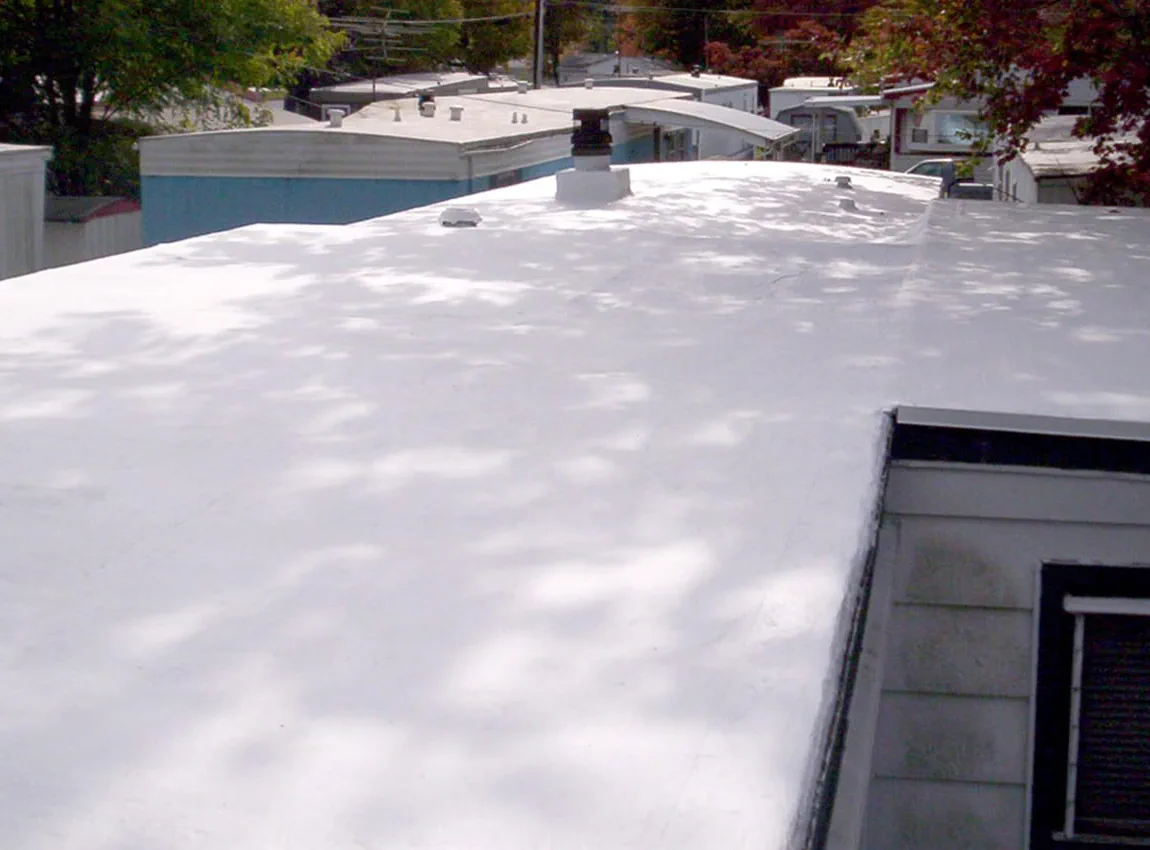
Most RVs have one of three roof types: EPDM rubber, TPO thermoplastic, or fiberglass. EPDM is the old standard - one single rubber sheet sealed with Dicor lap sealant at seams. TPO is newer, white or gray, sealed similar but more durable under UV.
Fiberglass is rigid, often on Class A motorhomes, and cracks instead of tears. We repair all three.
For sealant work, we use Dicor (the industry standard - specifically Dicor MD-2 or Dicor Self-Leveling) because it bonds to all roof types and flexes with thermal movement. For patches, we use Eternabond or Schwalm EPDM patches on rubber roofs, and Eternabond TPO patches on thermoplastic.
Fiberglass repairs use polyester resin and UV-cure methods. Gaskets on Dometic and Coleman-Mach AC units come OEM - we don't substitute cheap aftermarket.
Vents and plumbing stacks use Dicor collars. We stock common brands and order specialty parts same-day if needed.
We fixed a 2016 Coachmen Class A with a fiberglass cap that had a spider-web crack running 18 inches. The owner had no idea what was under that crack - could've been delamination, could've been cosmetic.
We ground it back, did a moisture test, found solid substrate, repaired with epoxy and UV cure, and sealed the whole area with Dicor. $650, two hours. For a Keystone RV with TPO, same crack would've been a patch job instead. The material dictates the fix.
Materials and brands we use:
- Dicor lap sealant (MD-2 and Self-Leveling)
- EPDM rubber roof patches (Eternabond brand)
- TPO roof patches (Eternabond TPO-specific)
- Fiberglass epoxy and UV-cure resin
- OEM Dometic and Coleman-Mach gaskets
- Vent and stack collars with Dicor seal
- Elastomeric roof coating for full recoats
How long does a roof leak repair take?
Most roof leak repairs finish in 2-4 hours. A single vent or gasket reseal is 1-2 hours. Small patches (EPDM or TPO under 12 inches) run 1.5-2 hours. Larger patches or multiple repair
What warranty covers your roof repair work?
All roof repairs carry a 90-day workmanship warranty. That means if the repair fails due to our installation - sealant separates, patch doesn't bond, gasket pops loose - we come back and fix it free. Parts are covered too, but only the part we installed (not the roof substrate or unrelated components).
Dicor and EPDM patches themselves carry manufacturer warranties (Dicor is 10 years from the maker, Eternabond patches are 20 years if installed correctly). We'll file claims on those if something fails after the 90 days, but the labor is on you after that window.
Cure time matters - if you expose the roof to heavy rain or pressure-wash before 48 hours, that voids our guarantee. We'll be clear about do's and don'ts before we leave. If the repair is warranty work from the RV manufacturer (factory defect), we'll handle it the same way - 90 days on our labor, manufacturer warranty on parts.
A 2015 Forest River Class A came in with AC gasket that failed at the 60-day mark - water came back. We resealed it at no charge because it was within our 90-day window.
Turned out there was a stress fracture in the AC flange underneath that we missed the first time. This time we replaced the whole gasket assembly and reinforced the mounting.
Covered under warranty. That's the kind of stand-behind-it service we provide. We'll also document everything with photos so you have proof of what was done if a dealer ever questions your work.
Warranty coverage details:
- 90-day workmanship warranty on all labor
- 90 days on Dicor and patch materials we install
- Manufacturer warranty on EPDM/TPO (10-20 years)
- Void if roof exposed to water before 48-hour cure
- No labor charge for warranty repairs in 90-day window
- We file manufacturer claims for parts after 90 days
- Factory defect claims handled same as our work
- Photo documentation provided for your records