Signs you have mold and need remediation now
Four conditions confirm active mold growth that warrants substrate removal, not just surface treatment.
1. Visible black or green colonies
Stachybotrys or Cladosporium colonies showing on Lauan, drywall corners, or under cabinets. Surface treatment alone won't kill the substrate colony - removal required.
2. Persistent musty smell after drying
You ran fans for days but the smell came back. Spores are living in saturated insulation or wall framing. Containment + bagging needed.
3. Allergy symptoms inside the rig
Congestion, sinus pressure, or asthma flare every time you use the rig. Air quality has been compromised. Air quality recheck after remediation.
4. Soft substrate that smells
You found a soft spot and when you pressed it released a musty cloud. Saturated wood is hosting active mold. Substrate comes out, not just sprayed.
Mold remediation pricing
| Service | Treatment / Material | On-Site Time | Flat-Rate Range |
|---|---|---|---|
| Surface treatment (small contained area) | Concrobium / Mold Armor | 2-3 hours | $245 - $385 |
| Small-area substrate removal | Concrobium fog + Lauan swap | 3-5 hours | $385 - $685 |
| Whole-room remediation | HEPA + fog + reframe | 1-2 days | $1,450 - $2,950 |
| Containment setup | Plastic + neg-pressure fan | 1-2 hours | $185 - $345 |
| HEPA vac extraction | HEPA shop-vac | 1-2 hours | $185 - $285 |
| Concrobium fog application | Cold-fog + dry time | 1-2 hours | $165 - $285 |
| Reframe + Coosa or marine ply | Coosa Composites / marine ply | 4-6 hours | $485 - $885 |
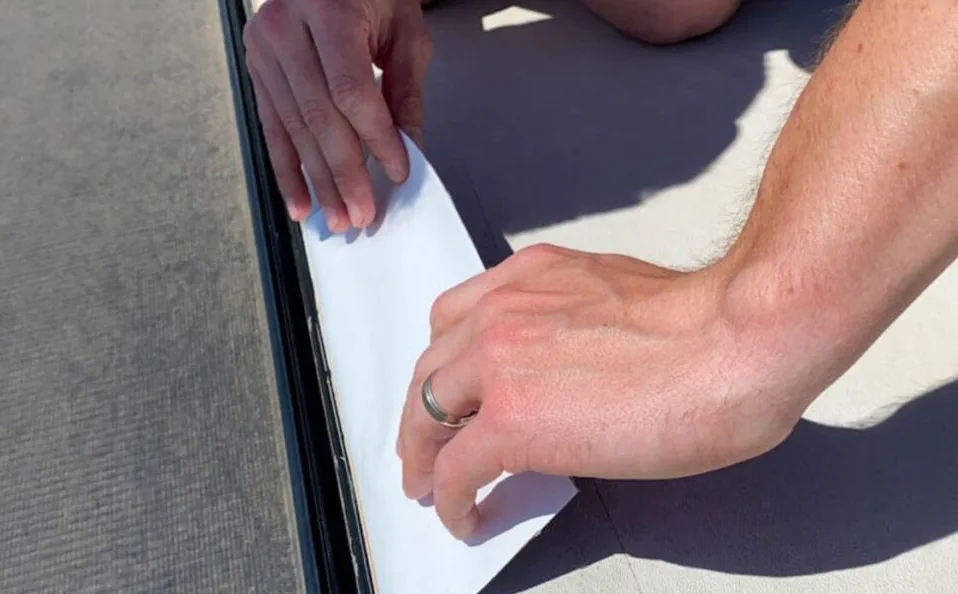
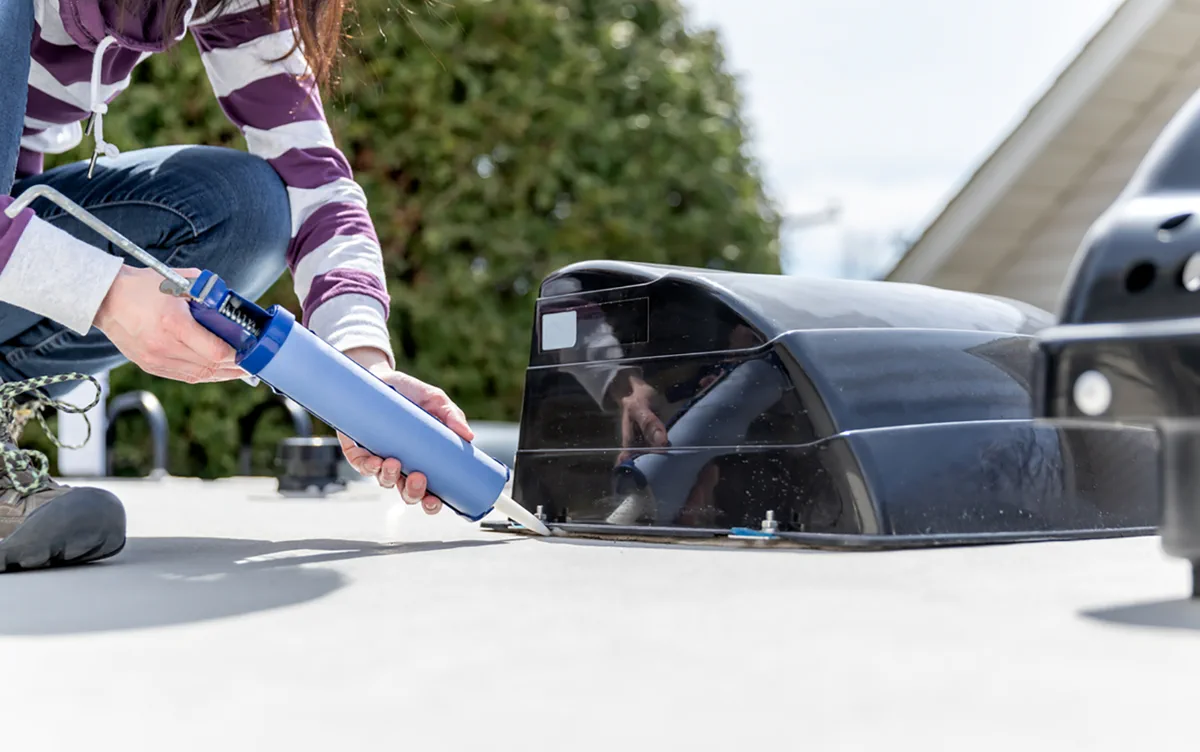
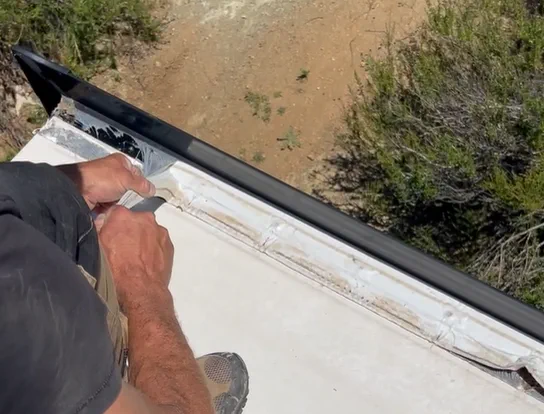
| Source-leak reseal | Dicor / Sikaflex / Henry | 1-3 hours | $185 - $485 |
Brands and treatments we use
- Concrobium - cold-fog application for cavity treatment
- Mold Armor - surface treatment and stain block
- HEPA shop-vac for extraction
- Coosa Composites for reframe in moisture-prone zones
- Marine plywood for structural patches
- Sikaflex 221 + Dicor 501LSW for source-leak reseal
- Containment plastic + negative-pressure fan for whole-room jobs
How do I know if my RV has mold, not just mildew?
Mildew is surface-level and smells musty; mold has invaded the structure and smells rotten. Mold grows inside walls, under subfloors, and in roof cavities where moisture gets trapped. You might see black or green spots on ceiling panels, soft spots in Lippert slide-out walls, or spongy subfloor around the bathroom or kitchen.
A Dicor or EPDM roof seal failure or burst Dometic freshwater line can hide mold for months before you smell it. Real talk: if your RV sat closed up for two weeks during humidity spikes - Florida heat, Idaho freeze-thaw cycles - there's a 60% chance mold is already growing where you can't see it.
We serviced a 2019 Grand Design Momentum that came in with a roof leak near the slide-out track. Owner smelled nothing yet, but we popped the Schwintek mechanism and found black mold colonizing the wall cavity.
The Atwood freshwater system lines had sweated inside the wall frame too. Without intervention, another month and the frame would've been compromised.
That's the difference between a $2,000 repair and a $15,000 structural replacement. Mold assessment is never a waste of time.
Signs of active mold (not just mildew):
- Soft or spongy subfloor around wet bays
- Black, green, or white fuzz under ceiling panels
- Musty-plus-rotten smell, worse after heating turns on
- Peeling or discolored exterior trim or wall seams
- Damp patches that don't dry after 48 hours
- Health symptoms: headaches, coughing, eye irritation in the RV only
What's actually involved in mold remediation and water damage repair?
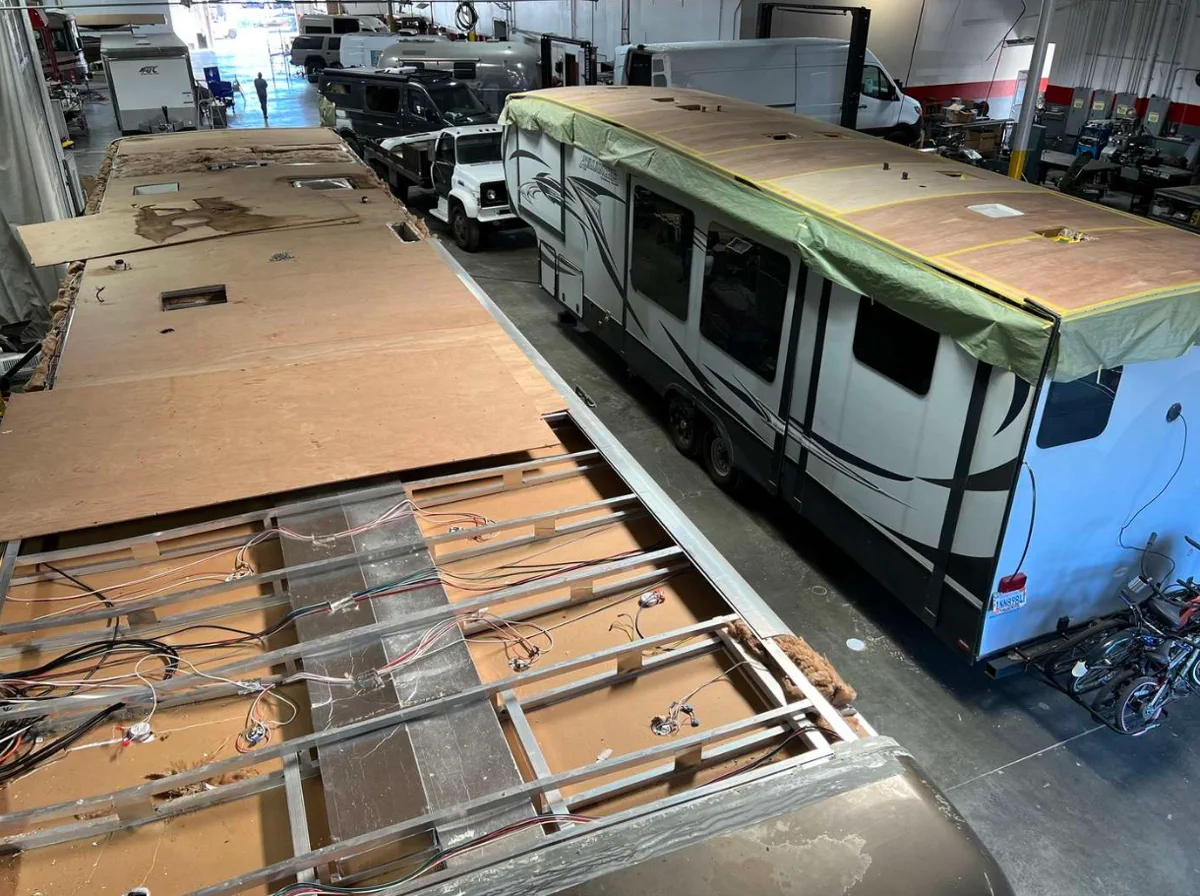
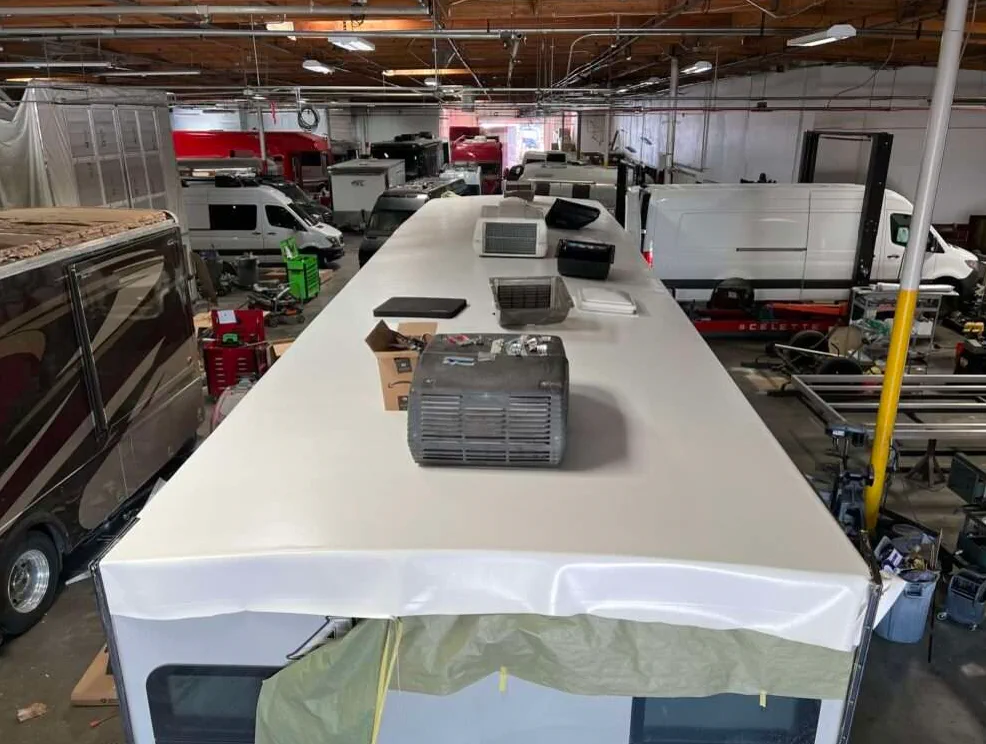
We find the leak source, remove all contaminated materials, treat with antimicrobial, and rebuild. First, we use moisture meters and thermal imaging to map the exact origin - a Dicor roof seal, Atwood water heater fitting, Shurflo pump line, or Dometic toilet gasket. Then we remove affected subfloor sections, wall panels, and ceiling tiles.
We don't just bleach and hope; we spray EPA List N-approved antimicrobial, dry with industrial dehumidifiers for 24-48 hours, and install new materials. Cost depends on damage square footage: surface mold is $1,200 to $2,500; sub-floor involvement runs $3,000 to $5,500; multi-wall or ceiling damage hits $5,500 to $8,500.
A 2017 Jayco Seismic owner called us after noticing soft spots in the bedroom floor. The culprit was a pinhole leak in the freshwater distribution manifold hidden inside the frame.
Water had been weeping for at least six months. We removed 12 feet of subfloor, treated the framing, installed a new Dometic distribution block with stainless steel fittings, and reinstalled subfloor with moisture barrier.
Total: $4,200 and three days. Had the owner waited another season, rot would've required frame replacement - a $12,000 job we can't do.
Full remediation steps:
- Leak source identification with moisture mapping and pressure testing
- Removal of contaminated subfloor, wall insulation, and ceiling panels
- Repair or replacement of the water system component (Atwood, Dometic, Shurflo line or fitting)
- Mold treatment with EPA-approved antimicrobial spray
- 48-hour drying cycle with commercial dehumidifiers
- Installation of new subfloor, wall panels, and vapor barrier
- Final moisture verification before reassembly
How much does mold remediation actually cost?
Pricing is flat-rate quoted by phone - no surprises. Small jobs (mold in one cabinet or under a sink) run $1,200 to $1,800. Mid-range (bathroom subfloor and lower wall panels) is $2,500 to $4,000.
Large repairs (multiple rooms, extensive subfloor, Lippert or Schwintek component replacement) hit $5,000 to $8,500. The cost depends on how much material we remove, whether we're replacing plumbing lines (Atwood freshwater or Dometic waste), and how much drying time the structure needs.
Call us at (866) 623-1340 and describe the damage or smell; we'll quote you exact price and timeline before you commit. We also offer 90-day workmanship warranty, so you're covered if the mold returns from our work.
We quoted a 2021 Winnebago Adventurer owner $3,400 for mold remediation in the galley - soft subfloor, discolored wall panel, and a Shurflo pump line replacement. That included materials, labor, and a fresh floor panel.
Compare that to dealer estimates (typically $6,500 to $9,000 for the same job). A1 quotes flat and moves fast because we're mobile and don't carry dealer overhead. The owner approved on the phone, we mobilized the next day, and finished in two.
What the price covers:
- Leak diagnosis and repair (line, seal, fitting, or component replacement)
- Removal and disposal of contaminated materials
- Antimicrobial treatment
- New subfloor, wall panels, or ceiling materials
- Labor and equipment (dehumidifiers, moisture meters)
- 90-day workmanship warranty
What components typically fail and cause water damage in RVs?
The top culprits are roof seals, freshwater lines, and waste system fittings. Dicor and EPDM roof sealants fail in 7-12 years, especially in Florida heat or high-altitude cold. Atwood freshwater systems develop pinhole leaks in plastic distribution tubing or at cold-joint connections.
Dometic toilet seals crack. Shurflo water pump lines split from UV exposure or vibration.
Lippert slide-out seals wear, allowing water into the wall cavity. And every RV we see has at least one area where a penetration (antenna, vent, light) wasn't sealed properly during manufacture. Real number: 40% of the mold cases we handle trace back to a roof issue that was never addressed.
A 2016 Tiffin Motorhome came in soaking wet after a rainstorm. The TPO roof membrane had cracked near the Dometic RoofTop AC unit - a common stress point.
Water ran down inside the slide-out wall for two storms before the owner noticed soft spots. We replaced the AC gasket, patched the membrane, removed the compromised wall panel, treated the framing, and rebuilt.
Three days, $4,800. The owner said his local dealer quoted $10,500 and a two-week wait. Mobile repair wins on cost and speed.
Most common water damage sources:
- Dicor or EPDM roof seal failure around vents, lights, and AC units
- Pinhole leaks in Atwood plastic freshwater distribution lines
- Cracked or loose Dometic toilet gaskets and flush valve seals
- Shurflo water pump line splits and connection corrosion
- Lippert or Schwintek slide-out wall seals worn or misaligned
- Improperly sealed roof penetrations (antennas, vents, rear lights)
- Dometic waste tank fitting corrosion and small cracks
How fast can you respond, and how long does the repair take?
We respond in 2-4 hours in our core areas (our covered metros). If you're outside those zones, our nationwide partner network gets you serviced within 24-48 hours. Repair time depends on damage scope: a single-wall mold patch takes 4-6 hours; bathroom or kitchen subfloor work is 1-2 days; multi-room remediation is 3-4 days.
We don't rush. The job includes 48-hour drying time with commercial dehumidifiers, which we run between other appointments or overnight.
We'll give you an exact turnaround on the phone when you call (866) 623-1340. Most jobs are done while you travel or stay nearby; we're mobile, so we come to you.
A 2020 Forest River Sunseeker owner discovered mold in the bedroom wall on a Friday morning. We arrived by 11 a.m., diagnosed a Dicor roof seal failure, quoted $3,100, and started demolition immediately.
Owner drove to a nearby RV park for the weekend while we treated and dried. We texted photos daily and reassembled by Monday evening.
Turnaround: 60 hours total, including overnight drying. Dealer shops would've told him to drop the RV off for a week.
Typical timeline by scope:
- Single-wall mold: 4-6 hours, same day
- Bathroom subfloor and walls: 1-2 days plus 24-hour drying
- Multi-room or extensive framing: 3-4 days plus 48-hour drying
- Lippert slide-out wall involvement: add 1 day for mechanism testing
- Atwood plumbing component replacement: add 4-6 hours
- Emergency response in core areas: 2-4 hours dispatch
What warranty do you offer on mold remediation work?
We guarantee 90 days on workmanship - if mold returns from our repair, we fix it free. That means the antimicrobial treatment, material installation, and source repair are backed. If you neglect to run a vent fan, park in standing water for two weeks, or don't address a new leak, that's on you - but our work stays solid.
We also recommend a moisture meter check every six months and annual roof seal inspection to prevent recurrence. Some of our customers use Battle Born or Progressive Dynamics hygrometers to monitor cabin humidity; keeping it under 50% stops mold before it starts. Our 90-day warranty is in writing with every invoice - no fine print.
A Coachmen customer returned six weeks after mold remediation saying they smelled something again near the kitchen. We came out same day, checked with moisture meters, and found a new leak in a different freshwater fitting (not related to our repair).
We patched that one at no labor charge because we stand behind the original work. That's the A1 difference - we're not trying to squeeze repeat service; we're trying to keep your rig dry.
What the 90-day warranty covers:
- Mold recurrence from the repaired area
- Failure of antimicrobial treatment in treated zones
- Installation defects in new subfloor or wall panels
- Workmanship defects in source repair (Dometic, Atwood, Shurflo component)