What are the first signs your RV roof is leaking?
Water stains on interior walls and ceiling panels are your first red flag. Most RV owners don't notice roof damage until they see brown marks inside - by then water has already started rotting the laminate underneath. Check around Dometic and Coleman-Mach AC units first; those are the biggest leak culprits because gaskets dry out and shrink.
Next, inspect the seams where the Dicor lap sealant meets the membrane. After 5-7 years, UV exposure turns sealant brittle.
Vent boots, antenna bases, and satellite domes are also common entry points. The problem: you can't see most damage from ground level. That's why we climb on every emergency call.
We had a 2019 Forest River travel trailer come in last month with water pooling behind the front bedroom wall. Owner had ignored a small stain for three weeks.
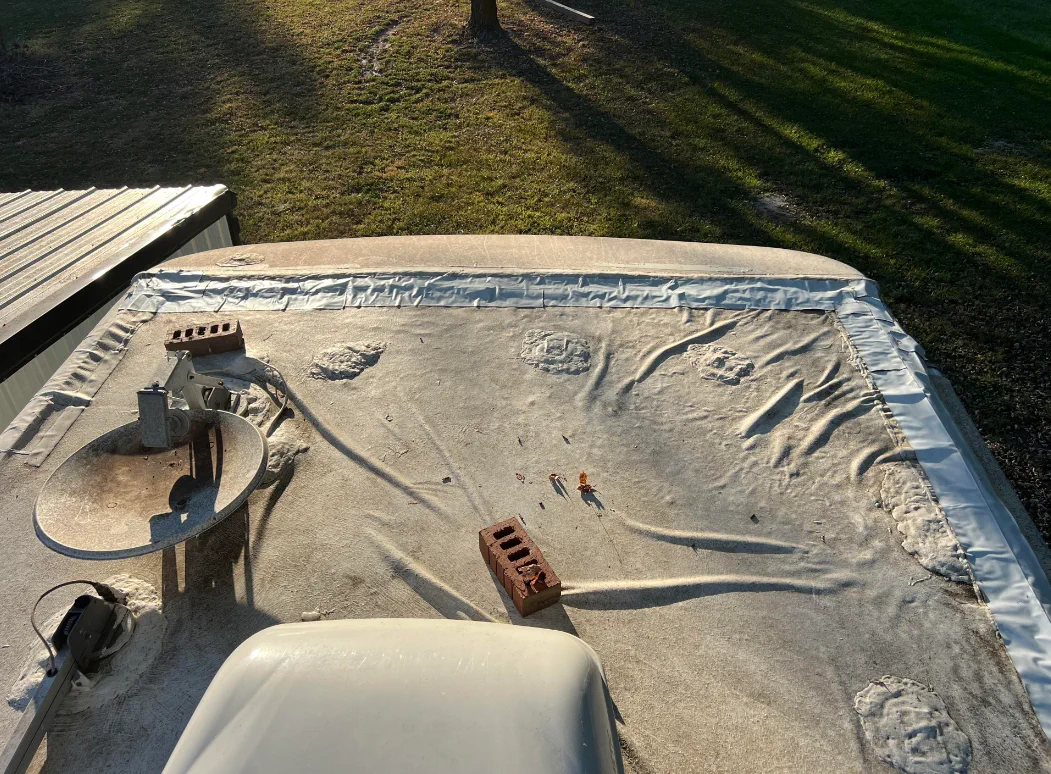
When we got up there, the EPDM membrane had cracked near the roof-to-wall junction, and moisture had soaked 18 inches into the laminate. Caught early, it's a $600 repair.
Caught late, that laminate gets replaced and you're looking at $3,500+. That's the difference between emergency response and waiting.
Early warning signs to watch for:
- Brown or tan water stains on ceiling panels
- Soft or spongy spots on roof when you walk it
- Musty or moldy smell in cabinets below roof
- Peeling interior headliner or wall fabric
- Visible gaps or cracks in sealant or membrane
- Condensation that won't dry inside on cool mornings
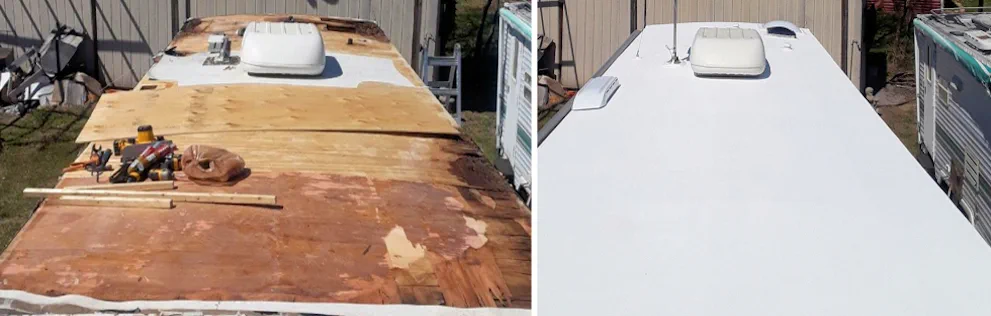
Signs you need emergency roof service right now
Four patterns drive almost every emergency roof call we run. If you see any of these during a storm or after one, treat it as urgent - the difference between a 2-hour fix and a 2-day restoration is hours, not days.
1. Active drip from a ceiling seam
Water coming through an interior ceiling joint, around a vent fan, or from the AC shroud means the membrane has a live entry point. Cut power to the AC, set a bucket, call us. We arrive with tarps and Eternabond.
2. Visible Dicor crack or lifted seam
You climbed up to check after a hailstorm and found Dicor cracked along a vent flange or a slide-roof seam lifted. Cover with a tarp until we get there - even good Dicor over a wet substrate fails fast.
3. Tree branch or hail strike
Anything that punctured the membrane or cracked the fiberglass cap. Tape the hole with anything waterproof, get the rig under cover if possible, and call. Insurance documentation starts before the patch goes on.
4. AC unit weeping during rain
Water dripping from the AC shroud means the gasket failed. The unit is fine - the seal between it and the roof opening is gone. Don't run the AC until we replace the gasket and reseal.
How does A1 diagnose and repair an active roof leak?
We find the leak source, document it, and seal it before water spreads - usually in one visit. First, we inspect the entire roof with a moisture meter and visual scan. On a TPO membrane we look for cracking at high-stress points (vent corners, AC flange, slide-room edge); on EPDM we look for shrinkage at the perimeter and pinholes from tree-debris strikes.
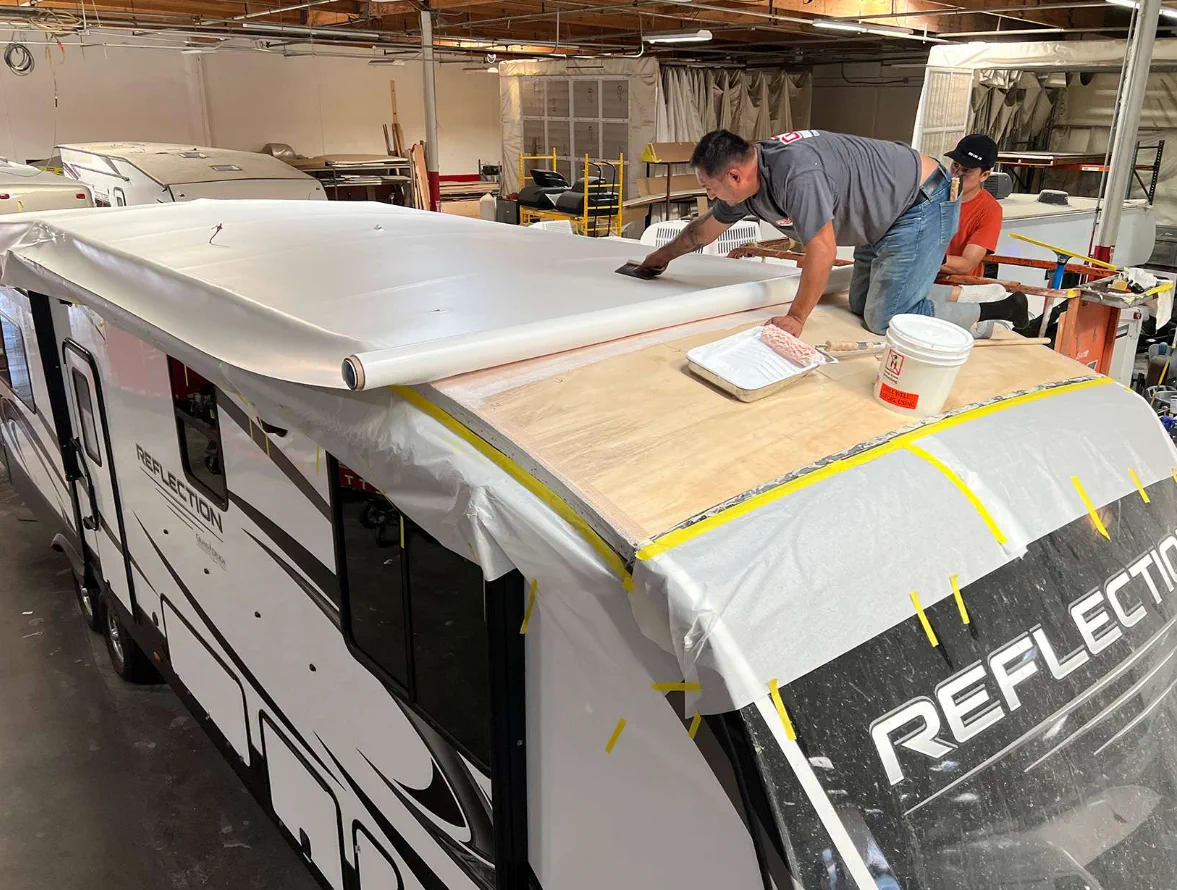
Once we find the entry point, we strip back compromised sealant or membrane to clean substrate, dry the area with heat or compressed air, then bond fresh material with the right primer for the membrane type. Tarps and Eternabond keep water out while permanent material cures.
- Visual inspection of entire roof surface and seams
- Moisture meter testing to locate water penetration
- Tarp deployment to stop active intrusion immediately
- Eternabond tape for temporary 24-48 hour seal
- Wet-vac extraction of standing water inside
- Drying fan setup for saturated insulation or Lauan
What's the actual repair process for different roof damage types?
Process depends on what's broken: lap sealant, membrane, gasket, or all three. For lap sealant separation (most common), we remove the old Dicor with a plastic scraper, clean bare membrane with solvent, and apply fresh Dicor 501LSW self-leveling on horizontal seams or Dicor 551 non-sag on vertical edges. For membrane punctures we use Eternabond tape as the emergency seal, then schedule a permanent EPDM or TPO patch with primer once the membrane is fully dry.
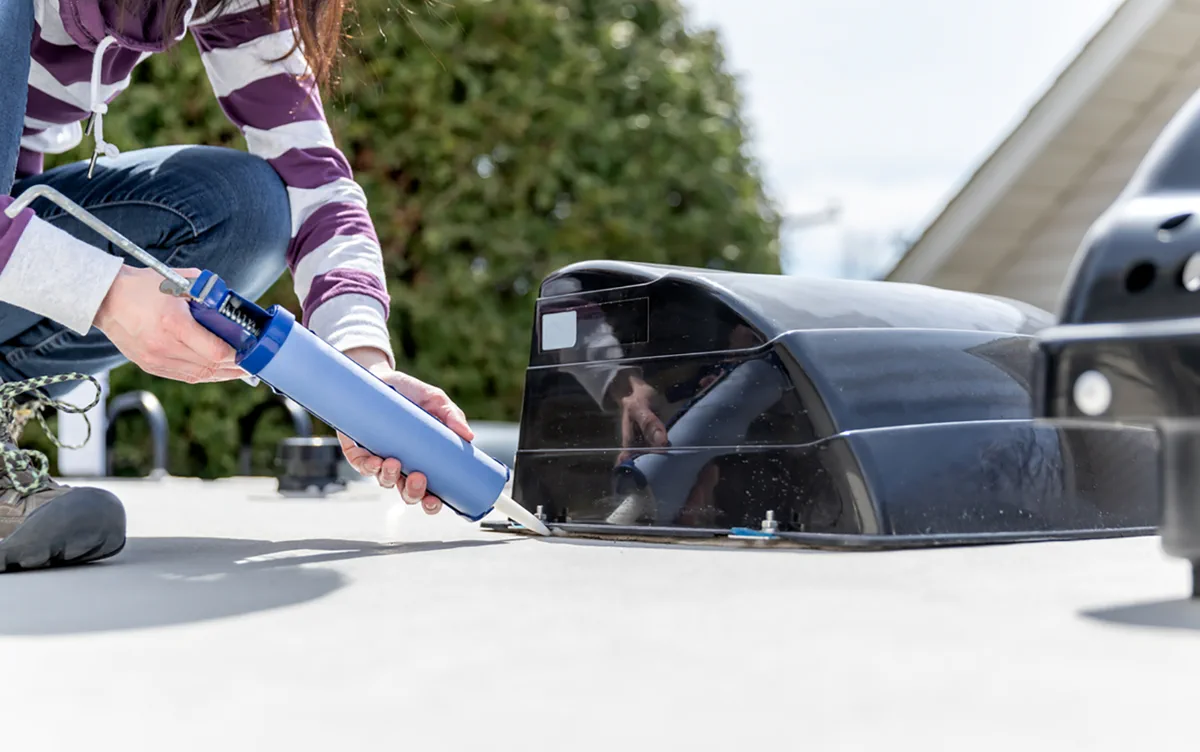
AC gasket failures get the unit lifted, the old gasket pulled, fresh foam-rubber gasket set, and a ProFlex RV perimeter bead. Skylight and vent fan reseals follow the same logic - butyl tape underneath, Dicor lap sealant on top.
Warning signs we look for during the repair walk-around:
- Brown rings on ceiling panels mean water has been migrating for weeks - catch it now or rip the laminate later.
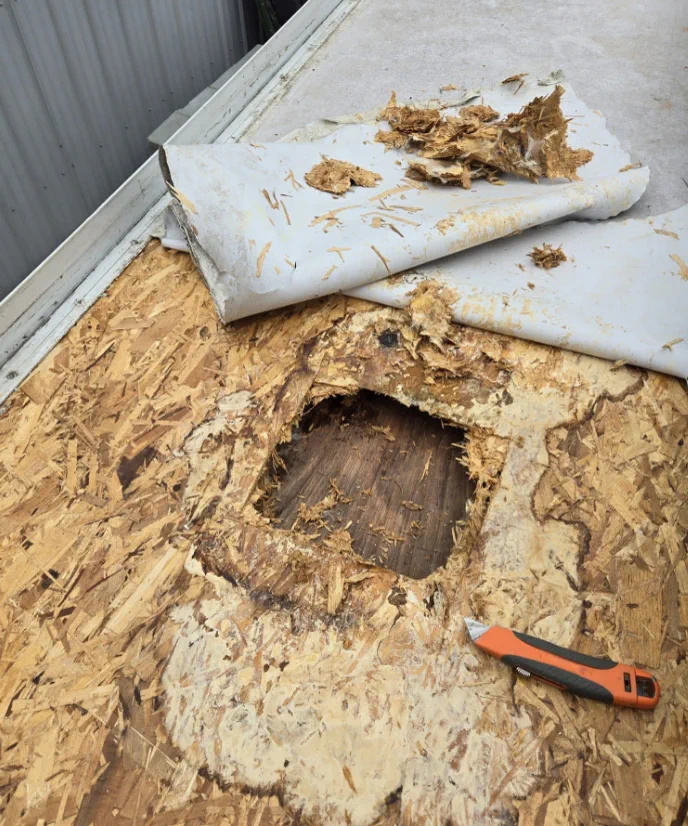
- Sub-roof rot. The plywood under the membrane has soaked through. Inspect immediately - patching over wet decking is a callback waiting to happen.
- Sidewall delamination near the roof edge - water has tracked down the laminate and lifted the fiberglass skin. Separate repair, but we flag it on the same visit.
Emergency roof repair pricing
Flat-rate, written quote at your site after the on-site inspection. Prices include parts, labor, and on-site dispatch.
| Repair | Parts / Brand | On-Site Time | Flat-Rate Range |
|---|---|---|---|
| Emergency tarp-and-seal (first visit) | Eternabond / tarp | 1 hour | $185 - $345 |
| Spot Dicor reseal (1-2 joints) | Dicor 501LSW / 551 | 1-2 hours | $245 - $485 |
| EPDM puncture patch (under 2 sq ft) | Alpha Systems EPDM | 2-3 hours | $385 - $685 |
| TPO puncture patch (under 2 sq ft) | Brite-Ply / Dur-A-Flex | 2-3 hours | $385 - $685 |
| AC gasket replacement | Dometic / Coleman-Mach OEM | 1-2 hours | $245 - $385 |
| Vent fan reseal (per vent) | Butyl tape / Dicor | 30-45 min | $145 - $245 |
| Wet-vac extraction + drying setup | Shop-vac / fans | 1-2 hours | $185 - $285 |
| Same-day return permanent reseal | Dicor / EPDM / TPO | 2-4 hours | $485 - $985 |
Repair vs replace - emergency triage decision guide
| Symptom | Repair Likely | Replace Likely |
|---|---|---|
| Single Dicor seam crack | Spot reseal - $245-$485 | If membrane is also crazed sitewide |
| Tree branch puncture | EPDM/TPO patch - $385-$685 | If branch broke through to decking |
| AC gasket weep | Gasket swap + reseal - $245-$385 | Almost never a replacement |
| Hail dimples | Inspect each, patch where needed | If membrane shows widespread micro-fractures |
| Soft spot underfoot | Never patch over wet decking | Decking + membrane - $1,950+ |
| Multiple lifted seams sitewide | Full reseal - $785-$1,250 | If membrane is 10+ years old |
Brands and materials we use on emergency calls
Every truck stocks the materials that fit every common RV roof type. We never substitute incompatible products to "make do" on an emergency.
- Dicor - 501LSW self-leveling lap sealant (horizontal), 551 non-sag (vertical edges)
- Eternabond - Roofseal tape for emergency seal, Webseal for membrane patches
- Alpha Systems - EPDM patch material with EPDM-specific contact cement
- Brite-Ply / Dur-A-Flex - TPO patch with primer and heat-bond gun
- Geocel - ProFlex RV polymer sealant for AC and vent perimeters
- Dometic / Coleman-Mach - OEM AC gaskets (Brisk II, Penguin II, Mach 8/15)
- Camco - butyl tape for skylights, vent flanges, and antenna mounts
How much does emergency RV roof repair cost, and what's included?
Pricing ranges $400-$1,200 for most emergency repairs; we quote flat-rate by phone before we roll. A single lap sealant reseal of a two-foot section runs about $400-$500. A vent or AC gasket replacement (material + labor) is $300-$400.
A membrane patch for a hole under three inches costs $500-$700. Full roof lap resealing on a 32-foot travel trailer is $1,200-$1,800.
Fiberglass crack repair with topcoat starts at $450. All quotes include diagnosis, materials (Dicor, patches, gaskets, sealant), labor, and cleanup.
We don't charge travel fees in our covered metros - it's built into the rate. Nationwide partner network charges travel time at $75/hour for jobs outside service areas.
A Grand Design Momentum owner had water pooling in two roof valleys - classic low-spot ponding. We cleaned and prepped both areas, filled low spots with self-leveling sealant, and applied Dicor coating over 20 square feet.
Cost: $950. Same membrane, same RV brand, but a bigger job than a single gasket.
Our phone quote was $950, and the bill was $950. No surprises, no upsells. That's how we work.
What emergency roof repair includes:
- Full roof inspection and damage diagnosis
- Material cost (Dicor, patches, gaskets, sealant, primer)
- Labor (hourly equivalent built into flat quote)
- Cleanup and debris removal
- 90-day workmanship warranty on all seals
- Photo documentation of repair
- No travel surcharge (our covered metros service areas)
How fast can A1 get to my RV for an emergency roof leak?
2-4 hour response in our core covered metros; nationwide partners typically 24-48 hours. When you call (866) 623-1340, we check truck location and availability immediately, ask a few questions about the roof type and what you're seeing inside (active drip vs stain, single source vs multiple), and pre-load the materials we need before rolling. Florida summer thunderstorm season and Idaho first-snow week are our two highest-volume periods - we route trucks accordingly. Outside our footprint, our nationwide partner network connects you with a certified mobile tech who carries the same materials.
What warranty covers your emergency roof repair, and what doesn't?
We guarantee 90 days on all labor and sealant work; material defects are covered under manufacturer warranty. If you follow post-repair care and the Dicor sealant we apply fails or pulls back within 90 days, we return and redo it free. Patches stay under warranty for one year if installed correctly.
Gaskets are covered for material failure under the OEM (Dometic, Coleman-Mach) warranty. What we don't cover: damage caused by exterior impact, RV storage near trees or power lines, or if you park in direct sun on black asphalt daily - UV and heat still age seals.
We also can't warranty roof leaks that return if the underlying membrane is laminate-rotted; that's structural damage requiring roof replacement, which is beyond our scope. Our 90 days is labor and sealing integrity.
A Tiffin Allegro owner came back after 60 days reporting a small weep on the edge of a patch we'd installed. We inspected, found we'd missed a hairline crack in the surrounding membrane, and resealed the entire patch perimeter under warranty.
No charge. That's what 90-day coverage means.
But if his roof had laminate delamination underneath - which happens on older RVs after years of sun - that's a different conversation. Laminate work requires a full roof replacement or fiberglass recovery, not a patch job.
Warranty coverage and limits:
- 90-day workmanship warranty on all sealant and labor
- One-year warranty on membrane patches if installed correctly
- OEM warranty on replacement gaskets (Dometic, Coleman-Mach, etc.)
- Does NOT cover impact damage or UV damage to surrounding roof
- Does NOT cover laminate rot or structural delamination
- Does NOT cover leaks returning due to inadequate interior ventilation
- Void if repairs are done by unlicensed technician after initial visit