Why is my RV generator hard to start or running rough?
A fouled or worn spark plug is one of the top reasons Onan and Cummins generators won't turn over or stumble under load. Spark plugs wear out from carbon buildup, fuel residue, and electrode gap drift - typically after 100-200 running hours depending on fuel quality and load cycles. When the gap widens, the ignition coil can't fire the plug reliably, especially in cold weather or at high altitude.
You'll notice slow cranking, backfiring, surging, or complete no-start even when the battery is good. We see this constantly in older Jayco and Forest River rigs where owners haven't run the gen set regularly.
Onan and Cummins both recommend plug inspection at 50 hours and replacement between 100-200 hours. Cheap or wrong-spec plugs fail faster. Your generator shouldn't make you guess - we diagnose it with a resistive load test and visual inspection.
A Winnebago owner in Tampa called us last month because his Onan 5500 wouldn't start after sitting six months. We found a spark plug gap that had grown to 0.045-inch - spec is 0.020-inch for that model.
The plug itself was carbon-black and loose in the cylinder head. We replaced both plugs with OEM Autolite units, set the gap correctly, and tested under load.
Generator fired on first crank and ran steady at 60 Hz. Cost him $240 total. That's the difference between a $50 plug job and a tow-in emergency call.
Spark plug failure symptoms:
- Hard starting, slow cranking even with charged battery
- Rough idle, surging, or sputtering under load
- Backfire or popping through the muffler
- Generator runs but shuts down randomly
- Low or no spark at the plug wire
- Visible carbon buildup or wet fouling on plugs
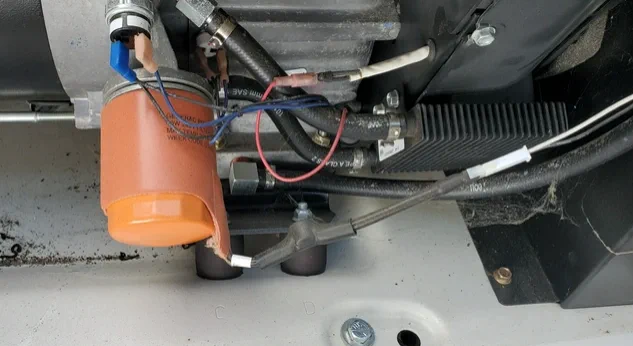
What exactly happens during a spark plug replacement?
We remove the old plugs, inspect the plug wells and gaskets, install new plugs gapped to spec, test ignition voltage, and run a load test to verify firing. This isn't just swapping ou
Disconnect spark plug wires or coil connectors safely
Inspect wire insulation and connector terminals
What plugs do you use, and does brand matter?
We install OEM-equivalent or OEM-original plugs - typically Autolite for Onan units and NGK or Champion for Cummins - and we set the gap to your specific generator's spec sheet. Generic auto-parts plugs are not recommended.
Stale fuel, dirty filter, or carb gum. Maintenance fixes most rough-run problems.
Bad start battery, glow plug, or starter solenoid. Diagnose before you crank it dry.
How often should spark plugs be replaced, and what does maintenance cost annually?
Replace spark plugs every 100-200 running hours, which usually works out to once per season or once every 12-18 months for typical RV owners. Heavy-use owners (full-timers, work rigs) might need them sooner. Cummins and Onan both list this in their service bulletins.
If your generator idles or runs lightly most of the time, carbon buildup speeds up the replacement clock. We've seen plugs last 250+ hours on well-maintained Onan units, but that's the exception.
A spark plug replacement job with us runs $180-$320 including labor, diagnostics, and a 90-day warranty. That's a flat rate quoted by phone before we even roll up.
Add-on services like fuel filter swap ($120-$180), air filter service ($80-$130), or oil and filter change ($150-$250) bring a full generator tune-up to $500-$700 depending on what your unit actually needs. We inspect everything and tell you what's due.
A Grand Design owner who full-times in Florida called us in June for his annual service. His Onan hadn't been serviced in three years.
We quoted: spark plugs ($240), oil and filter ($180), fuel filter ($140), and air filter ($95). Total $655.
He authorized all four. The plugs were carbon-fouled, the oil was dark, and the fuel filter had visible sediment.
After service, his generator ran quieter, started faster, and held 60 Hz steadily. He's scheduled annual maintenance now.
Annual RV generator maintenance breakdown:
- Spark plug inspection and replacement: $180-$320
- Oil and filter change: $150-$250
- Fuel filter replacement: $120-$180
- Air filter service or replacement: $80-$130
- Coolant flush or top-up: $100-$200
- Full tune-up package: $500-$700 (all items)
Can you handle spark plug replacement on my specific generator model?
We service Onan and Cummins RV generators - the two brands in 95% of motorhomes and travel trailers. Onan QuietDiesel, Onan Cummins (which Onan now owns), Cummins Onan, and Cummins Po
What warranty do you give on spark plug work, and what if a plug fails early?
We back all spark plug replacement work with a 90-day workmanship warranty - if a plug misfires or a wire we installed fails, we repair or replace it free. The warranty covers labor and parts we installed, not wear-out from normal use. If you run bad fuel, overheat the generator, or operate at extreme altitude without service, that's on you.
But if we installed a plug incorrectly, gapped it wrong, or used a faulty plug from our stock, we make it right. We also warranty the diagnosis - if we say your rough idle is spark plugs and it's not, we keep troubleshooting.
We don't charge you for being wrong. This is a small industry and we build long-term relationships with owners.
You can call back anytime in that 90 days and we'll get to you fast. A1 RV Repair is RVIA and RVDA certified, and our warranty is in writing. We also carry liability insurance, so you're covered if something goes sideways.
A Winnebago owner from Sarasota had us replace plugs, and two weeks later one spark plug wire corrosion returned under the new insulation boot. He called us back annoyed.
We drove out, replaced the entire wire and both plugs again under warranty, no charge. Turned out his generator compartment had a roof leak we spotted while we were there.
We told him to get that sealed (not our job, but we warned him). He did, and he's had zero issues since. That's standing behind your work.
What our 90-day warranty covers:
- Labor to reinstall or replace a failed plug or wire
- Defective plugs or wires from our stock
- Incorrect gap or part number we specified
- Faulty diagnosis (we troubleshoot at no extra cost)
- Parts and labor for any related ignition failure we caused
- Does NOT cover: fuel contamination, overheat damage, extreme altitude stress, abuse