What does a bad hydraulic line actually do to your leveling system?
A cracked or leaking hydraulic line kills your RV leveling system because it bleeds pressure before it reaches the jacks. HWH and Lippert Level-Up systems rely on continuous hydraulic pressure - if a line ruptures or develops a slow weep, the pump works harder, the control board gets confused by pressure drop, and your jacks stop extending evenly or stop cold. You'll see slow jack movement, uneven leveling, or complete system failure.
Lines fail from road vibration, UV damage, rubbing against sharp edges, corrosion from moisture, and age - we see 10+ year old rigs with compromised lines all the time. The fix is pressure-test diagnosis, line replacement, fluid top-up, and system bleed.
We pulled into a 2018 Forest River Sunseeker in Tampa last month - owner said the rear driver jacks wouldn't extend past halfway and the whole rig was tilted. Turned out the driver-side return line had a micro-crack where it rubbed against a frame rail.
The Lippert Level-Up pump was screaming but pressure was dropping 40 PSI before it hit the jack cylinders. We replaced 8 feet of hose with OEM crimped fittings, flushed the fluid, bled the system, and tested it.
Leveling was perfect again. Total time: 2.5 hours.
Signs your hydraulic lines need attention:
- Jacks extend slower than normal or unevenly
- Hissing or dripping under the RV during leveling
- Control board error codes or flashing lights
- Leveling doesn't hold level after engine off
- Oily smell near hydraulic components
- Visible cracks, kinks, or crushed hose sections
How do we diagnose which line is leaking and why?
Diagnosis starts with a pressure gauge on the pump outlet - we're looking for steady 1500-1800 PSI during jack extension. If pressure drops or oscillates, we trace each line with a shop light and your eyes on the ground watching for drips. Most leaks show up immediately under load - fluid weeps from a fitting, a micro-crack, or a puncture.
We also check for rubbing damage by following lines along the chassis and slide-out mechanisms. If a line is kinked or partially crushed, hydraulic flow backs up and creates heat that can degrade fluid and damage the control board over time. Once we locate the problem area, we isolate that section and measure it for replacement.
A 2016 Jayco Jay Flight owner in Boise called us because their Level-Up system worked fine but the control panel kept cutting out. Most shops would've blamed the board.
We pressurized the circuit and found a pinhole leak on the supply line - so small it barely dripped, but it was sucking air into the system and causing pressure spikes. The fix: replace 12 feet of line from pump to the manifold block, reinstall OEM Lippert fittings, and pressure-bleed all air bubbles. Control board came back to life immediately.
Our diagnostic process:
- Pressure test pump output at idle and under jack load
- Visual inspection of all hose runs for damage
- Listen for pump noise and control board relay clicks
- Check fluid color for contamination or moisture
- Test jack extend/retract speed on each circuit
- Run system through full cycle and monitor pressure graph
What's the actual repair process for a hydraulic line replacement?
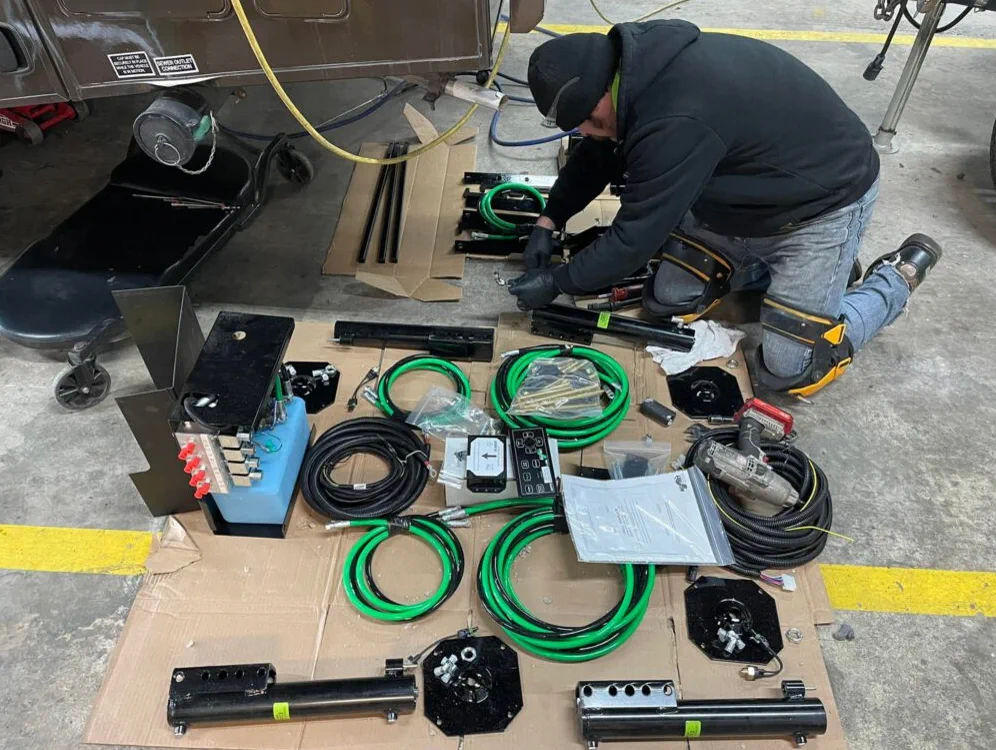
We start by relieving system pressure through a manual valve, then disconnect the bad line at both ends and pull it clear of the chassis. Depending on line location - under the rig, up near the pump, or routed through slide-outs - we may need to remove trim panels or lower a slide to access both fittings. We measure the line length, count the bend angles, and order OEM replacement hose pre-crimped with the right fitting size (usually -8 or -10 JIC flare).
Never use push-to-connect fittings on hydraulic circuits - they fail under pressure. After the new line is installed, we top up the fluid reservoir and bleed the system by cycling jacks slowly while opening a bleed valve to release trapped air.
A 2019 Grand Design Momentum owner's HWH system had a return line rubbing against the frame - took us 45 minutes just to access it because the line ran behind the water tanks. We pulled the tanks forward slightly, replaced the 10-foot return line with new hose and crimped fittings, zip-tied it away from sharp edges with 1-inch foam padding, then bled the circuit three times to get all air out. The system was dead silent after that.
Repair checklist:
- Depressurize the hydraulic system safely
- Disconnect hose fittings at both ends
- Remove damaged hose from chassis
- Measure replacement line length and routing
- Install OEM crimped hose with correct fittings
- Top up reservoir with manufacturer-spec fluid
- Bleed air through manual valve during jack cycling
- Pressure test the new line under full load
How much does hydraulic line repair actually cost?
Hydraulic line repair runs $280-$650 depending on line length, location, and whether fittings need replacement. A simple 6-foot supply line with basic fittings is on the lower end; a 12-foot return line routed through tight chassis spaces with manifold block fittings can run higher. We always quote flat-rate by phone once you describe the symptoms and RV model - no surprises on the invoice.
Parts (hose, fittings, fluid top-up) typically run $80-$220. Labor is 2-3 hours in most cases. If we find multiple leaks or need to replace the manifold block or control board, we quote those separately.
We quoted a Winnebago Adventurer owner $420 for a driver-side supply line and fitting replacement. Turned out when we got under there, the return line had the same problem - we offered to do both for $680 total instead of quoting separately. Customer saved money, system was bulletproof afterward, and they left us a five-star review.
What affects the price:
- Line length - short runs under 8 feet are cheaper
- Location difficulty - chassis vs. slide routes vary
- Fitting type - manifold block fittings cost more
- Fluid type - HWH vs. Lippert use different specs
- Same-day emergency response - add $150 in core areas
- Additional repairs found during diagnosis
How long does it take and can you come today?
Most hydraulic line repairs take 2-3 hours on-site, start to finish. That includes diagnosis, depressurization, disconnection, removal, new line installation, fluid top-up, bleeding, and pressure testing. Straightforward supply lines under the chassis: closer to 2 hours.
Return lines routed through tight spaces or behind tanks: 3-4 hours. If we have to remove interior panels or lower a slide to access the line, add 30 minutes. A1 offers 2-4 hour emergency response in our our covered metros core service areas - call (866) 623-1340 in the morning and we'll route a tech to you the same day in most cases.
A Keystone Cougar owner in Jacksonville blew a return line on a Friday and called us at 10 AM. We had a tech there by noon, diagnosed it in 20 minutes, and finished the full replacement and pressure test by 3 PM. Owner was back on the road for the weekend.
Timing factors:
- Simple supply line replacement - 2 hours
- Return line with difficult access - 3 hours
- Multiple leaks or manifold work - 4+ hours
- Same-day service available in core service areas
- Rural or remote locations - add travel time
- Weekend or emergency calls - premium response available
What warranty covers your hydraulic line work and what if it leaks again?
A1 backs all hydraulic line repair with a 90-day workmanship warranty - if the line or fitting fails due to our installation, we fix it at no charge. That covers installation defects, improper crimps, or routing issues. Warranty does NOT cover new damage from road hazard (hitting a rock, frame contact), UV degradation over time, or contaminated fluid clogging a new line.
We pressure-test every job before you leave - you see the gauge and the system holding steady. If a line starts weeping three weeks after we install it, call us and we'll come back and recheck.
A 2017 Tiffin Motorhome customer called us six weeks after a line replacement saying they noticed a slow drip. We came out, found the issue was a tiny particle of old fluid blocking the new fitting, not a crimping problem.
We flushed the fitting, bled the system again, and charged them nothing - warranty covered it. That's the kind of stand-behind-it service we give.
What the 90-day warranty includes:
- Installation defects on crimped fittings
- Hose failure caused by our work
- Improper routing or zip-tie issues
- Air trapped in lines after our bleed job
- Pressure test failure at time of work completion