About 60% of cooling-unit calls we run are boiler-tube blockages from off-level storage - the ammonia/hydrogen/water mixture inside the sealed cooling unit settles when the rig sits unused, sodium chromate crystals form in the boiler, and circulation stops. The other 40% split between true ammonia leaks (you'll see yellow crystalline residue at the back of the unit), warped cooling fins from a unit that ran hot for weeks before owner noticed, and rare defects in the sealed welds.
Once a cooling unit fails, there is no field repair - the entire welded core gets pulled and replaced. We carry Dometic RM and Norcold N7X / N8X cooling unit cores plus thermal paste, fin cleaners, and complete install hardware on every truck so most cooling-unit calls finish in one visit.
Signs your absorption fridge cooling unit needs replacement
Four patterns cover almost every cooling-unit call we run. If your rig is doing one of these, the diagnosis is usually quick:
1. Cools on neither propane nor 120V
Burner ignites and electric element heats, but interior temperature won't drop below 50F. Cooling unit has failed and replacement is the only fix - typical full-replacement scope.
2. Yellow powder residue at the back of the unit
Tell-tale sign of a true ammonia leak. Cooling unit is unrecoverable. Replacement runs $1,450-$2,450 including the new sealed core, thermal paste, and 4-hour cold-soak verification.
3. Fridge worked all summer, dead after winter storage
Off-level storage caused boiler crystallization. Tip-revive test (free during diagnostic) succeeds about half the time; if it fails, cooling unit is toast.
4. Slow cool-down or short-cycling
Cooling unit on the way out but not fully failed. Sometimes a deep clean of the burner orifice and flue stack buys another season; sometimes replacement is the right call now.
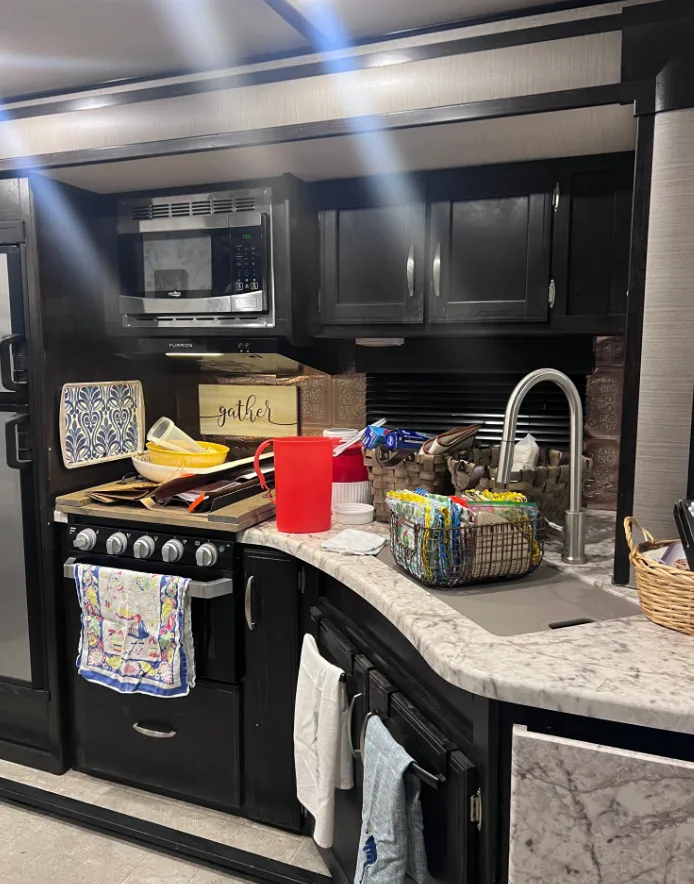
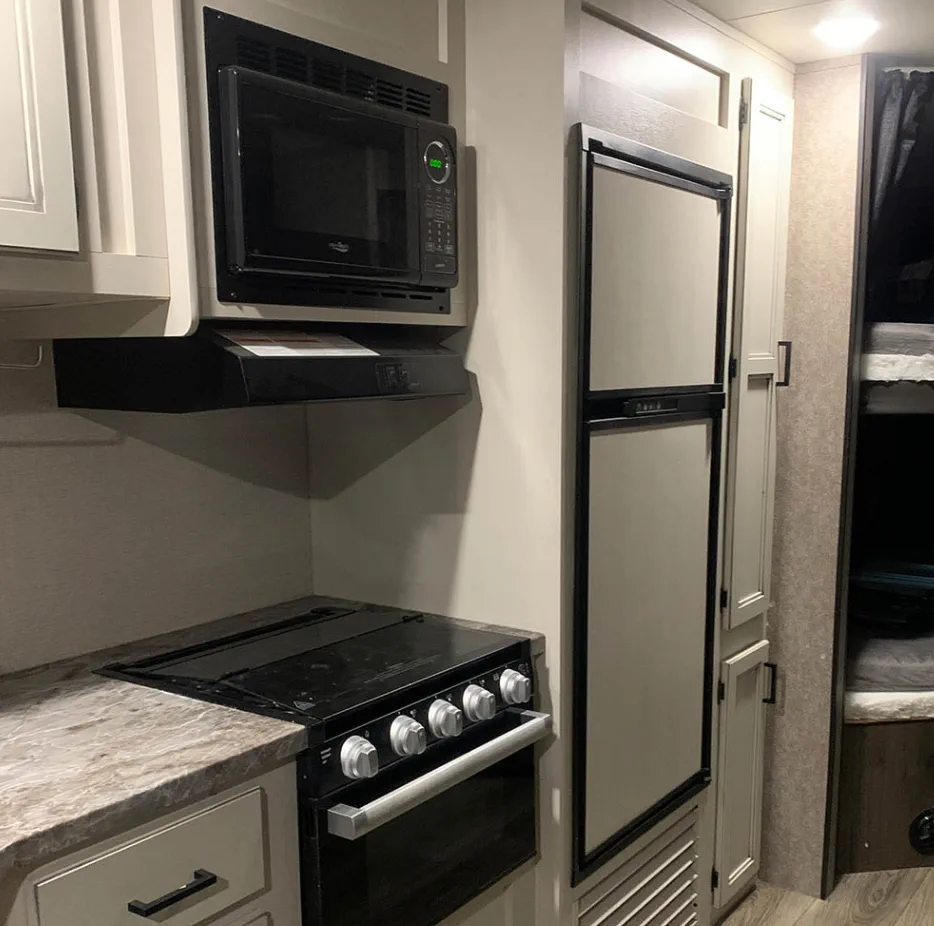
What we fix - mobile RV cooling unit service
What's included in a mobile cooling unit service call
Every call starts with a 30-minute diagnosis. We pull the exterior vent panel, look for the yellow ammonia residue, check the flue stack for blockage, run a 15-minute propane-only temperature test, and then a 15-minute 120V-only test.
If both fail to drop interior temp, the cooling unit is condemned and we move to replacement. If one source works and the other doesn't, the issue is gas-side or electric-side and we diagnose those separately.
For replacement, the standard sequence is: pull the fridge from the cabinet, disconnect propane and 120V, unbolt the cooling unit core from the fins, install the new sealed cooling unit with fresh thermal paste at every fin contact point, reinstall the fridge, restart on both propane and 120V, and run a 4-hour cold-soak verification with the door closed before sign-off. We tag the unit with install date and serial number for warranty registration.
Absorption fridge cooling unit pricing
Flat-rate, written quote at your site before any work starts. No hourly creep, no diagnostic surcharge, no after-the-fact "oh by the way."
| Service | Parts / Brand | On-Site Time | Flat-Rate Range |
|---|---|---|---|
| Dometic RM3962 cooling unit | Dometic OEM core | 5-7 hours | $1,450 - $2,150 |
| Dometic RM2454 cooling unit | Dometic OEM core | 5-7 hours | $1,450 - $2,250 |
| Norcold 1210 cooling unit | Norcold OEM core | 5-7 hours | $1,650 - $2,450 |
| Norcold N7X cooling unit | Norcold OEM core | 5-7 hours | $1,550 - $2,350 |
| Norcold N8X cooling unit | Norcold OEM core | 5-7 hours | $1,650 - $2,450 |
| Difficult-access surcharge | Slide-out interference / dual-unit | add 1-2 hours | add $150 - $300 |
| Tip-revive diagnostic | Boiler-blockage clearing test | 30 min on-site, 24 hr rest | free with cooling unit call |
| Burner orifice clean & tune | Burner brass orifice + thermocouple | 1 hour | $135 - $245 |
| Thermistor swap | Dometic / Norcold OEM | 30 min | $165 - $245 |
| Control board (Dinosaur or OEM) | Dinosaur Electronics / OEM | 1-2 hours | $385 - $685 |
Repair vs replace - quick decision guide
| Symptom | Repair Likely | Replace Likely |
|---|---|---|
| Cools electric, fails propane | Burner orifice + thermocouple - $135-$245 | Almost never replace cooling unit |
| Cools propane, fails electric | Heating element + thermostat - $185-$285 | Almost never replace cooling unit |
| Slow cool-down, both modes | Flue clean + thermistor - $245-$385 | If 8+ years old and condition borderline |
| Fails both modes after winter storage | Tip-revive test - free | If tip-revive fails: cooling unit replacement |
| Yellow residue at back / ammonia smell | Never - leak is fatal | Cooling unit replacement - $1,450-$2,450 |
| Cabinet warped or stained from prior leak | Box patching $585-$1,250 | If structural: full fridge replacement consideration |
Convert vs replace cooling unit
If your absorption fridge is more than 10 years old and the cooling unit fails, it's worth a conversation about residential conversion. Cooling-unit replacement runs $1,450-$2,450 and gets you another 8-12 years on the original fridge.
Residential conversion runs $1,850-$3,250 and gets you a quieter, colder, longer-lived fridge if your power setup supports it. We'll quote both and let you choose.
Brands and parts we install
We carry stock for the absorption-fridge brands that show up on most modern coaches.
- Dometic - RM3962, RM2454, RM3962, RM3862 cooling units; OEM thermistors and control boards
- Norcold - 1210, N7X, N8X cooling units; OEM thermistors and control boards
- Dinosaur Electronics - aftermarket replacement boards for both Dometic and Norcold (more reliable than original on some models)
- Thermal paste - high-conductivity paste rated for cooling-unit fin contact
- OEM hardware - mounting screws, brackets, vent panels, and gas-line fittings
Warranty - what's covered after we swap your cooling unit
A1 backs every cooling-unit replacement with a 90-day workmanship warranty - if our install caused the issue, we fix it free. Dometic and Norcold OEM cooling units carry a 1-2 year manufacturer warranty against defect (rare but possible - we replaced one factory-defective unit a few years back at no charge). We register the unit serial number in your name so you own the manufacturer coverage.
Our warranty covers bad thermal paste application, ammonia line damage during install, or any operational issue traceable to install error. It does not cover damage from running off-level, impact damage, or owner misuse.