Dometic, Coleman-Mach, and Furrion start and run capacitor replacements on rooftop RV air conditioners. Metered diagnosis, OEM-spec microfarad match (30+5, 40+5, 50+5 dual-run), on-site in 60-90 minutes. Flat-rate quoted by phone before we dispatch.
About 70% of "my AC won't cool" calls finish as a capacitor swap. The capacitor is a small dual-section can mounted inside the rooftop unit's electrical box - one section kicks the compressor through its compression stroke at startup, the other holds the condenser fan in run.
Heat and vibration are the two killers. In Florida summers, internal capacitor temps cycle past 160 F day after day, the dielectric film breaks down, and the cap loses microfarads until the compressor can't start under load. The compressor hums and trips the breaker, the fan still spins because it's on a separate winding, and you get no cold air at the register.
Four patterns cover almost every call. If your unit is doing one of these, the diagnosis is usually quick:
Thermostat calls for cool, you hear a low hum from the rooftop, then a click as the breaker trips or the internal overload opens. Classic weak start capacitor. Compressor windings are fine; the cap just can't kick rotation. $150-$300 fix.
Condenser fan spins, you feel airflow at the register, but the air is room-temp. The fan section of the dual-cap is healthy; the start section has dropped.
Compressor never engages. Same swap as above.
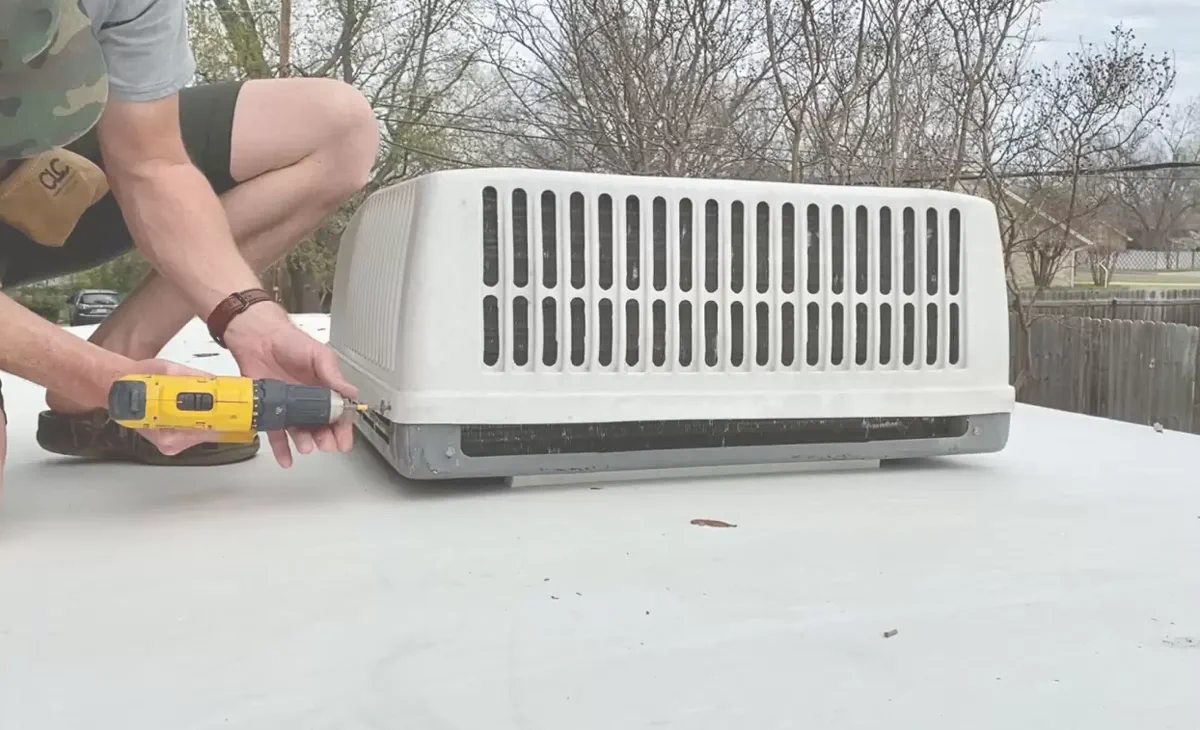
Pop the rooftop shroud, look at the capacitor can. Bulging top, rust streaks, or oily residue at the base means the cap is venting and the dielectric is finished. Replace before it fails the compressor.
30A pedestal breaker pops every time the compressor tries to start. Could be a weak cap pulling locked-rotor current too long, or a soft-start that's overdue. Both diagnose in under 30 minutes with a clamp meter.


Every call starts with a 10-minute diagnosis on the rooftop. We pull the shroud, kill power at the breaker, discharge the cap with a bleed resistor, and meter the existing capacitor against its nameplate microfarad rating. From there it's a like-for-like swap, a clamp-meter check on compressor inrush at restart, and a 15-minute run cycle to confirm the unit pulls evaporator output down to 38-42 F at the register before we close everything back up.
For replacements, the standard sequence is: kill 120V at the panel, remove the rooftop shroud, photograph the existing wiring (HERM, FAN, C terminals), discharge the cap, lift it out of the bracket, mount the new OEM-spec dual-run unit, transfer the spade leads to matching terminals, restart, verify amp draw, and reseat the shroud.
| Symptom | Repair Likely | Replace Likely |
|---|---|---|
| Compressor hums, won't start | Capacitor swap - $150-$300 | If hard-start trips contactor |
| Fan runs, no cooling | Run-section dual-cap swap - $150-$285 | If compressor seized from heat |
| Bulging or oily cap | Always replace - $150-$300 | N/A |
| Breaker trips on startup | Cap swap + soft-start - $245-$485 | If compressor amp draw is high |
| Cap good but still no cool | Contactor or fan motor - $185-$485 | If refrigerant has bled out |
| Cap good, compressor groans | Soft-start kit - $245-$385 | If compressor windings short |
| Repeated cap failures | Voltage drop / shore feed test - $165 | Hughes Autoformer add-on |
Flat-rate, written quote at your site before any work starts. No hourly creep, no diagnostic surcharge, no after-the-fact "while we were up there."
| Service | Parts / Brand | On-Site Time | Flat-Rate Range |
|---|---|---|---|
| Dual-run capacitor swap (30+5) | Dometic Brisk II / Penguin II OEM | 60 min | $150 - $245 |
| Dual-run capacitor swap (40+5) | Coleman-Mach 8 / 15 OEM | 60 min | $165 - $265 |
| Dual-run capacitor swap (50+5) | Furrion Chill / Houghton OEM | 60-90 min | $185 - $300 |
| Capacitor + soft-start combo | OEM cap + SoftStartRV / Micro-Air | 1.5-2 hours | $345 - $485 |
| Contactor + capacitor | OEM 24V or 120V coil | 1-1.5 hours | $245 - $385 |
| Capacitor + fan motor | Dometic / Coleman OEM motor | 1.5-2 hours | $385 - $585 |
| Vintage Airxcel / ASA cap | OEM-spec source 24-hour | 60-90 min | $245 - $385 |
| Voltage drop + shore feed test | Fluke meter + amp clamp | 45 min | $165 flat |
A1 RV Repair quotes a phone range before scheduling, then writes you an exact quote at your site before turning a wrench. No hourly creep, no after-the-fact "while we were up there," no diagnostic surcharge buried at the bottom of the invoice.
We carry the three most common dual-run microfarad ratings on every truck plus the OEM-equivalent caps for the rooftop units we see most.
A1 backs every capacitor replacement with a 90-day workmanship warranty and the OEM 1-year parts warranty (typical for Dometic and Coleman-Mach). If a capacitor we installed fails inside our 90-day window from any cause we can trace back to the install, we replace it free including the trip. Outside that window, the OEM warranty covers the part itself; labor is on the customer.
Repeat capacitor failures usually point to an upstream issue - low shore voltage at the pedestal, a weakening compressor pulling locked-rotor current too long, or a marginal contactor that's letting voltage swing on each cycle. We diagnose those root causes rather than just swapping caps until you stop calling.
Nationwide mobile coverage from a network of certified A1 RV Repair technicians, with same-day response in our core metros. Click any city for local response times and to book online.
Our flat-rate price for a capacitor replacement runs $180-$320 all-in, covering the capacitor itself, any start or run capacitor components we find degraded while the unit is open, and a full system cycle test before we leave. Most RV dealers land in the $400-$550 range because they bill hourly labor and mark up parts separately - if the job runs long, you absorb the overage.
With flat-rate mobile pricing, the number we quote before we start is the number on the invoice, no surprises. Capacitors also rarely fail in isolation on older units, so while we have the shroud off we check the run and start components together rather than leaving a marginal part that brings you back in two weeks. The one edge case: if we pull the shroud and find the compressor or fan motor has also failed, we stop, show you what we found, and let you decide how to proceed before any additional work begins.
A phone diagnosis gets us most of the way there before we roll the truck. The two symptoms that point almost directly to a capacitor are a compressor that hums but won't kick on, and a fan that runs but produces no cooling - those two patterns cover the large majority of capacitor failures we see in the field.
We'll ask you the AC brand, the model if you can read the label on the shroud, and roughly how old the unit is, because capacitor specs vary by manufacturer and we want to carry the right replacement rating on the truck. That said, we always confirm with a multimeter on-site before touching anything - a capacitor reading within spec shifts our attention to the run winding, the contactor, or low refrigerant, which are different repairs with different costs. If the phone call points somewhere other than the capacitor, we'll tell you that too before we dispatch, so you're not paying for a parts run that misses the actual problem.
Older units and less common brands like vintage Carrier aren't a problem in practice. On-site, we pull the data plate off the unit and record the exact microfarad rating, voltage tolerance, and physical form factor - those three specs are what matter, not the brand name on the shroud.
We then source a matching OEM or OEM-equivalent capacitor through our supplier network, usually within 24 hours. You pay the same flat rate regardless of how long sourcing takes.
The reason we don't substitute cheap aftermarket capacitors is straightforward: an undersized or low-grade cap causes the compressor to hard-start repeatedly, which accelerates wear and can turn an $80 capacitor job into a $900 compressor replacement. If the unit is old enough that no spec-matched part exists anywhere in the supply chain, we'll tell you that before ordering anything and walk you through your replacement options honestly.
In our core service areas in our covered metros, we aim for a 2-4 hour emergency response window when your AC goes down hard. Call immediately and confirm your exact location so we can route the closest available tech rather than working off a general service zone.
Outside those areas, we dispatch through our nationwide certified-tech partner network, and timing depends on tech availability in your region. When the tech arrives, the first step is a capacitor load test and compressor amp draw check - that matters because a seized compressor or a failed contactor can look identical to a bad capacitor from the outside, and pulling parts before confirming the cause wastes time and money.
If the capacitor is confirmed as the failed component, most jobs wrap up within an hour since we carry common start and run capacitor values on the truck. If the compressor itself has seized, that's a different repair path and we'll walk you through your options before any further work begins.
The OEM part warranty runs 1 year on the capacitor itself - Dometic and Coleman-Mach both stand behind their components for that window. Our labor warranty covers 90 days, meaning if the same capacitor fails from the same cause within that period, we come back at no charge for the labor.
Where it gets more nuanced is root cause: a capacitor that fails a second time is usually telling you something else is wrong upstream - a weak breaker allowing voltage swings, a failing compressor drawing excess amperage, or a wiring issue creating intermittent shorts. Those are separate faults that require their own diagnostic and are not covered under the original capacitor warranty.
If you call us back on a repeat failure, we pull the original work order, review what we documented the first time, and tell you honestly whether it qualifies as a warranty return or a new problem before any new billing starts. That conversation costs you nothing.
We come to you - A1 RV Repair is mobile-only, no shop, no haul-in required. Capacitor replacement is one of the cleaner mobile jobs: we pull the shroud on the roof unit, test the run and start capacitors with a capacitance meter right there, swap the failed component, and confirm the compressor and fan motor are drawing correct amperage before we close everything back up.
If amperage is high even after the swap, that tells us the compressor itself is struggling, which is a different conversation than a capacitor job. The whole repair happens at your site whether you're in a campground, a driveway, or a storage lot.
We dispatch across our nationwide network, and through our nationwide certified-tech partner network if you're outside those states. You stay parked and keep your plans.
Yes. Dometic units on Forest River rigs from 2010 to present use standard capacitor form factors, so fitment is almost never an issue.
Before we dispatch, we verify the exact microfarad rating your unit calls for - typically 30+5 or 40+5 uF, though a handful of Dometic models spec a different value depending on compressor tonnage. We pull that rating from the nameplate data you give us and match it to a confirmed stock capacitor before the tech rolls out, so there's no second trip for a different part.
The one edge case worth knowing: if your AC unit has been swapped out at some point and a non-factory replacement is sitting up there, the original label may not match what's actually installed. In that case the tech reads the capacitor directly, confirms the rating against the compressor and fan motor specs, and sources the correct part on the spot before any wiring is touched.
We cover both urban and remote locations in Idaho's Treasure Valley and surrounding areas, though scheduling does vary by distance from our Boise/Nampa service hub. For campgrounds and dispersed sites well outside the metro, we route the nearest available technician to your coordinates - remote location adds travel time, not job complexity.
When you reach out, have your GPS coordinates or a campground name and site number ready so we can give you an honest arrival estimate. The capacitor repair itself is straightforward once a tech is on-site: we test the existing capacitor under load, confirm the failure mode, swap in a matched replacement from truck stock, and cycle the unit to verify the compressor and fan motor return to normal operation. One thing worth knowing - if your AC has been running on a weak capacitor for a while, the compressor may show signs of heat stress, which we will flag before closing out the job.
Same flat-rate pricing in every city. Same RVIA-certified mobile crew. Same parts-on-truck approach so most calls finish in one visit.
Often booked together with this repair. Same crew, same flat-rate, same on-site visit.