The honest answer to whether RV solar is worth it depends almost entirely on where you park, not what you spend. The same 600-watt array that hits payback in 22 months parked in Quartzsite stretches to 5+ years parked in Olympia. Sun hours are the real currency, and most blog math ignores them by averaging the country into one number.
RV solar ROI by region (sun hours, not just panels)
The biggest mistake owners make is comparing solar quotes without comparing the regions those quotes will operate in. Peak sun hours - the hours per day a panel produces at full rated output - vary by more than 2x across the lower 48, and that single number reshuffles every payback estimate.
The table below maps the eight U.S. climate regions A1 RV Repair services to their average peak sun hours, expected payback for an active boondocker, payback for a hookup-only camper, and the panel watts we recommend for a typical travel trailer or Class C. The data follows NREL solar resource maps for direct horizontal irradiance.
| Region | Peak sun hours/day | Boondocker payback | Hookup-only payback | Recommended panel watts |
|---|---|---|---|---|
| Desert Southwest (AZ, NV, southern CA) | 6.5 - 7.0 | 18 - 24 months | 3 - 4 years | 400 - 600W |
| Florida / Gulf Coast (FL, AL, MS, LA) | 5.5 - 6.0 | 22 - 30 months | 3 - 5 years | 400 - 600W |
| Texas / Southern Plains (TX, OK) | 5.0 - 6.0 | 24 - 32 months | 4 - 5 years | 400 - 600W |
| Mountain West (CO, UT, ID, WY) | 5.0 - 6.0 + altitude UV | 24 - 30 months | 4 - 5 years | 400 - 600W |
| Southeast (GA, SC, NC, TN) | 4.5 - 5.5 | 28 - 36 months | 4 - 6 years | 500 - 700W |
| Midwest / Mid-Atlantic (IL, OH, PA, VA) | 4.0 - 5.0 | 30 - 42 months | 5 - 7 years | 600 - 800W |
| Northeast (NY, MA, ME, VT) | 3.5 - 4.5 | 36 - 48 months | 6 - 8 years | 600 - 800W |
| Pacific Northwest (WA, OR coastal) | 3.0 - 4.0 | 42 - 60 months | 7+ years | 800 - 1,000W |
How much does an RV solar install cost?
A professional RV solar install runs 1,800 to 8,500 dollars depending on array size, charge controller class, and whether the rig already has a battery bank that can absorb the harvest. The lithium battery bank is a separate purchase that we cover in the RV lithium upgrade guide - those numbers are not in this post.
The breakdown for solar-only (panels, controller, wiring, mounts, install) lands at 1,800 to 2,500 for a 200W starter, 2,800 to 3,800 for a 400W mid-range, and 5,500 to 8,500 for a 600 to 800W setup with name-brand MPPT and full monitoring. DIY kits trim 800 to 1,200 in labor but routinely cause warranty issues we end up fixing.
Pricing is mobile-service based, which means our techs come to your storage location with all the hardware and complete the job in your driveway. Material costs follow industry pricing tracked by the Solar Energy Industries Association, and component selection follows NRVIA inspection standards for RV-rated wiring and over-current protection.
How many panels do I need for a 30-amp coach?
A typical 30-amp travel trailer or Class C with LED lighting, a 12V compressor fridge, and a MaxxFan needs 400 to 600 watts of solar in 5+ sun-hour regions, and 800 watts or more in the Pacific Northwest. That math comes from a 1,800 to 2,400 watt-hour daily demand divided by regional peak sun hours, then derated 25 percent for real-world losses.
Panel count depends on whether you pick 100W or 200W panels and what fits between your roof vents. A 600W array fits as three 200W rigid panels (about 200 square feet of roof real estate) or six 100W panels for tighter layouts around skylights and A/C shrouds. Rigid mono panels from Renogy's RV product line are the most common rooftop pick we install.
Class A coaches and 50-amp fifth wheels with residential fridges and inverter loads usually need 800 to 1,200 watts because daily consumption climbs to 2,800 to 4,500 watt-hours. We size those against the actual battery monitor data from the customer's last boondocking week, not a generic spec sheet.
Does RV solar work in cloudy weather?
Yes, but at 10 to 30 percent of rated output. A 600W array making 350 watt-hours per hour in full sun drops to 60 to 180 watt-hours per hour under heavy overcast, which means a fully cloudy day produces 700 to 1,200 watt-hours instead of the 3,000 to 4,000 a sunny day delivers. The system never quits; it just throttles.
Modern monocrystalline panels also have a quirk worth knowing - they actually run more efficiently in cool temperatures. A 70-degree spring day in Fort Pierce with scattered clouds often outproduces a 95-degree July afternoon because panel output declines about 0.4 percent per degree above 77 Fahrenheit. Cool and bright beats hot and bright.
The fix for cloudy regions is overpaneling, not switching technology. Pacific Northwest owners in Bellingham and Seattle who size for sunny averages will be disappointed; sizing 30 to 50 percent above the load instead of dead-on lets the array still hit demand on heavy-cloud days. NREL's irradiance maps are the right reference for this calculation.
Roof-mount vs portable - which is right?
Roof-mount solar wins for full-timers, snowbirds, and anyone who parks in open lots. Panels harvest while driving, while in storage, and without setup time. Portable suitcase panels win when you park under trees and want to chase the sun across an open clearing, or when you share one panel set across multiple rigs in a fleet.
The hidden trade-off with roof-mount is roof penetration - every mount foot is a sealant joint that has to stay watertight for the next decade. We use Z-bracket or tilt-bracket feet bonded with 3M VHB tape plus Dicor self-leveling lap sealant over the screw heads, which is the same hardware spec factory roof-mount kits ship with. Skip the cheap stamped aluminum feet that flex.
Portable suitcase panels skip the roof entirely but cost more per watt and need someone to set them up, take them down, and store them between trips. Most owners who start with portable end up adding a roof array within two seasons because the daily setup chore wears thin. Travel trailers with shaded campsite preferences are the legitimate exception.
What's the payback period for boondockers vs hookup campers?
Active boondockers see solar payback in 18 to 36 months across most of the country. Hookup-only campers stretch to 4 to 7 years because the avoided cost is just generator fuel and propane fridge runtime, not nightly campground fees. Use pattern is the single biggest payback variable after region.
The math: an active boondocker spending 100+ nights per year off-grid avoids roughly 35 to 65 dollars per night in campground fees ($3,500 to $6,500 annual savings) plus 800 to 1,500 dollars in generator fuel. A 4,500-dollar 600W system pays back in 14 to 22 months. The same system on a hookup-only rig only avoids generator fuel and propane, which moves payback to 4-plus years.
The non-financial value matters too. Solar buys access to Bureau of Land Management dispersed camping, Forest Service sites, and remote staging that simply doesn't have hookups.
Many owners say that access alone justifies the install, regardless of dollar payback. RV electrical service teams can scope an install from your boondocking pattern.
Do I need a new charge controller (PWM vs MPPT)?
Use MPPT, not PWM, for any array over 200 watts. MPPT (Maximum Power Point Tracking) controllers convert the extra panel voltage into usable amps, capturing 95 to 98 percent of array output. PWM (Pulse Width Modulation) controllers clamp panel voltage to battery voltage, throwing away 20 to 30 percent of what the panels produce.
The price gap is small versus the lifetime gain. A quality 50A MPPT controller from Victron's BlueSolar and SmartSolar lines runs 200 to 450 dollars; a comparable PWM is 80 to 150. On a 600W array that delivers 200 to 350 extra watt-hours per day, the controller pays back in less than two boondocking seasons.
Charge controllers also run battery-bank logic. Lithium banks need a controller with a configurable absorb voltage and a low-temperature cutoff; lead-acid wants a three-stage profile with periodic equalization. The lithium-bank pairing is covered in our lithium upgrade guide - the controller and bank decisions are made together, not sequentially.
Can I add solar to a Class B van conversion?
Yes, with caveats. Class B vans (Sprinter, Transit, ProMaster) have limited roof real estate (typically 30 to 50 square feet) which caps the array around 300 to 600 watts depending on whether you also need roof space for a fan, A/C, and skylight. That capacity matches most van loads since vans run smaller fridges and lighter electrical demand than trailers.
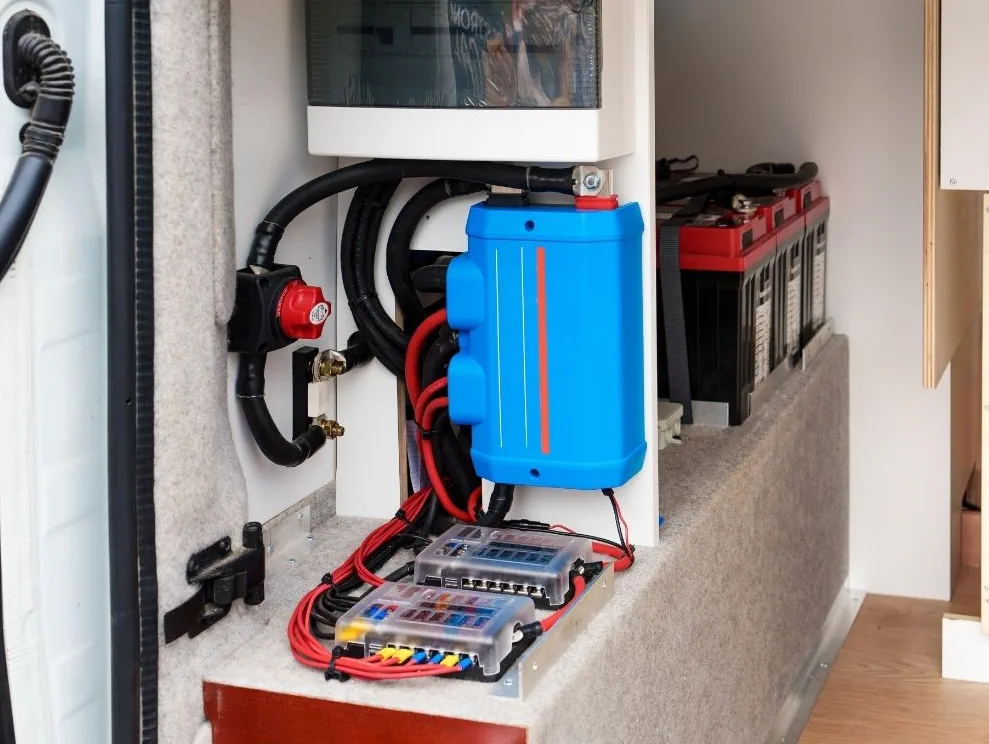
The advantage on a van conversion is that lithium banks, MPPT controllers, and inverters all bolt into the same compact bay, which simplifies wiring runs and reduces voltage drop. We typically install a 400W array with a 30A MPPT controller on a Sprinter, paired with a 200 to 300Ah lithium bank to give 2 to 4 days of off-grid runtime in the Desert Southwest.
Stealth conversions and class-8 sleeper buildouts have the same constraint as Class B vans, with one extra trick - flexible solar laminate panels add 100 to 200 extra watts of capacity on curved or low-clearance roofs where rigid panels won't fit. Adhesion is the gotcha; flexible panels need direct contact with the substrate or they overheat and delaminate.
What roof-mount hardware avoids leaks?
Use stainless or aluminum Z-bracket or tilt-bracket mounting feet bonded to the roof with 3M VHB tape plus Dicor self-leveling lap sealant over every screw head. That hardware spec is what factory roof-mount kits ship with, and it survives a 10-year roof inspection cycle without resealing. Skip stamped aluminum feet that flex.
Bracket placement matters as much as bracket quality. Locate feet directly over a roof rafter or stringer, not in unsupported membrane span, so road vibration doesn't fatigue the EPDM or TPO. We pull the interior ceiling panel during install to verify substrate location before drilling - that step catches 90 percent of the leak issues we see on aftermarket installs.
Annual sealant inspection is part of the package. A1 RV Repair adds solar mount feet to the standard RV roof repair seasonal walk-through, and we touch up Dicor on any chalking or cracking before water finds the substrate. Pair the inspection with reseal timing covered in our RV roof repair seasonal guide.
Solar system tier by use case
The right system tier depends on how you camp, not how much roof you have. Boondockers and full-timers need bigger arrays and lithium banks; hookup-only owners can run lean. The table below maps the four common use cases to component recommendations and total install cost.
| Use case | Recommended panel watts | Charge controller | Battery bank size | Total install cost | Payback period |
|---|---|---|---|---|---|
| Hookup-only weekender | 200W | PWM 30A or MPPT 20A | 100Ah lead-acid or 100Ah lithium | $1,800 - $2,500 | 5 - 7 years |
| Occasional boondocker | 400W | MPPT 30A | 200Ah lithium | $2,800 - $3,800 | 2.5 - 4 years |
| Active full-timer | 600 - 800W | MPPT 50 - 60A | 300 - 400Ah lithium | $5,500 - $7,500 | 14 - 24 months |
| Snowbird (FL/AZ winters) | 600W | MPPT 50A | 200 - 300Ah lithium | $4,500 - $6,500 | 22 - 30 months |
Pricing assumes mobile install at your storage location with name-brand components (Renogy or Victron panels, Victron or Battle Born MPPT, Battle Born or Lion Energy lithium). DIY kits run 30 to 40 percent less but skip the wiring inspection, voltage-drop calculations, and warranty support that come with professional install.
How do I plan an RV solar install that actually pencils out?
Start with the boondocking week audit, not the panel catalog. Run a battery monitor or shunt for one full off-grid week and log daily watt-hour consumption - that single data point sizes the array more accurately than any spec sheet rule of thumb. Then pull peak sun hours for your home region from the NREL solar resource map.
Pair the install with adjacent system upgrades. Solar plus a lithium bank is a single conversation, not two; the controller, wiring gauge, and inverter sizing all change based on bank chemistry. The same visit can also catch water pump health and roof reseal needs since the tech is already on the rig.
Verify the install. After commissioning, log a second boondocking week with the new array online and compare actual watt-hour harvest against the design number.
Battery bank installation partners well with solar commissioning because the same diagnostic gear validates both. RV electrical service stays on call for any post-install troubleshooting needed in year one.