The lithium upgrade question splits owners into two camps: the ones who pay it back inside four years and the ones who never get there. The variable that decides which camp you land in is not battery price; it is how many off-grid hours you put on the bank and what climate the rig lives in. A 400Ah LiFePO4 install in Houston for a residential-fridge full-timer is a different math problem than the same hardware in a hookup-only weekender stored in Port St. Lucie.
Lithium upgrade ROI by region and use case
The biggest mistake owners make is treating lithium as a universal upgrade. Climate region and use case shift the payback period from 3 years to never, and in some configurations the supporting charger and inverter spend more than the batteries themselves.
The table below maps four primary RV use cases against four climate regions A1 RV Repair services. It shows realistic payback period, recommended bank size, whether BMS heating is required, and whether the existing charging system needs replacement. Use the row that matches your storage region and how you actually use the rig, not how you imagine using it.
| Region & use case | Payback period | Recommended bank | BMS heating | Charger upgrade |
|---|---|---|---|---|
| Hot-climate boondocker (TX, AZ, FL) | 3-4 years | 300-400 Ah | Not required | Lithium-ready converter required |
| Hot-climate full-timer (residential fridge) | 2-3 years | 400-600 Ah | Not required | Inverter-charger + DC-DC charger |
| Hot-climate snowbird (winter Florida) | 4-6 years | 200-300 Ah | Not required | Lithium-ready converter recommended |
| Hot-climate hookup-only weekender | 8+ years (rarely worth it) | 100-200 Ah | Not required | Optional |
| Cold-climate boondocker (ID, MT, WY) | 4-5 years | 300-500 Ah | Required (internal or pad) | Lithium-ready converter required |
| Cold-climate full-timer (winter use) | 3-4 years | 400-600 Ah | Required (internal heating) | Inverter-charger + DC-DC charger |
| Mountain West snowbird (summer use) | 5-7 years | 200-300 Ah | Optional (storage above freeze) | Lithium-ready converter recommended |
| Cold-climate hookup-only weekender | Rarely worth it | 100-200 Ah | Required if used in winter | Optional |
How much does an RV lithium upgrade cost in 2026?
A complete RV lithium upgrade in 2026 runs $3,500 to $7,500 installed, broken into roughly $1,800 to $4,500 for the battery bank itself and another $400 to $1,500 for the charger, inverter, monitor, and DC-DC charger work that goes with it. The price band depends on bank size and how much of the existing electrical chain has to be replaced.
Battery pricing collapsed about 35% from 2022 to 2026 as cell-grade LiFePO4 production caught up with demand. A 100Ah drop-in cell now sits around $450 to $750, depending on whether it has internal BMS heating and Bluetooth monitoring. Premium banks from Battle Born or Lithionics still run a 30 to 50% premium for warranty and support.
Supporting hardware decides the total. Victron MultiPlus inverter-charger spec sheets show a true LiFePO4 charging profile and remote monitoring; older WFCO and Magnatek units do not. Skipping that swap is the most common reason A1 RV Repair sees a lithium bank chronically stuck at 80% state of charge.
How long does lithium take to pay back?
For a hot-climate boondocker putting 80 to 120 nights off-grid per year, a $4,000 lithium upgrade typically pays back in 3 to 4 years through avoided lead-acid replacement cycles and the residential-fridge or air-conditioner runtime that lead-acid simply cannot deliver. A flooded lead-acid bank in the same use lasts 18 to 36 months; AGM stretches that to 4 to 6 years; LiFePO4 holds 80% capacity for 8 to 15 years.
Hookup-only weekenders rarely cross the breakeven line. A bank that lives at 100% state of charge most of its life sees almost no cycle wear, so a $200 lead-acid pair does the same job as $2,000 of lithium for that owner. The math only flips once off-grid hours pile up.
Full-timers get the steepest payback curve because they use the bank every single day. A residential-fridge coach on shore power one week and boondocking the next will hit 250 to 350 cycles per year, where lead-acid degrades visibly inside 18 months. Lithium absorbs that pattern without complaint.
Does lithium work in cold weather?
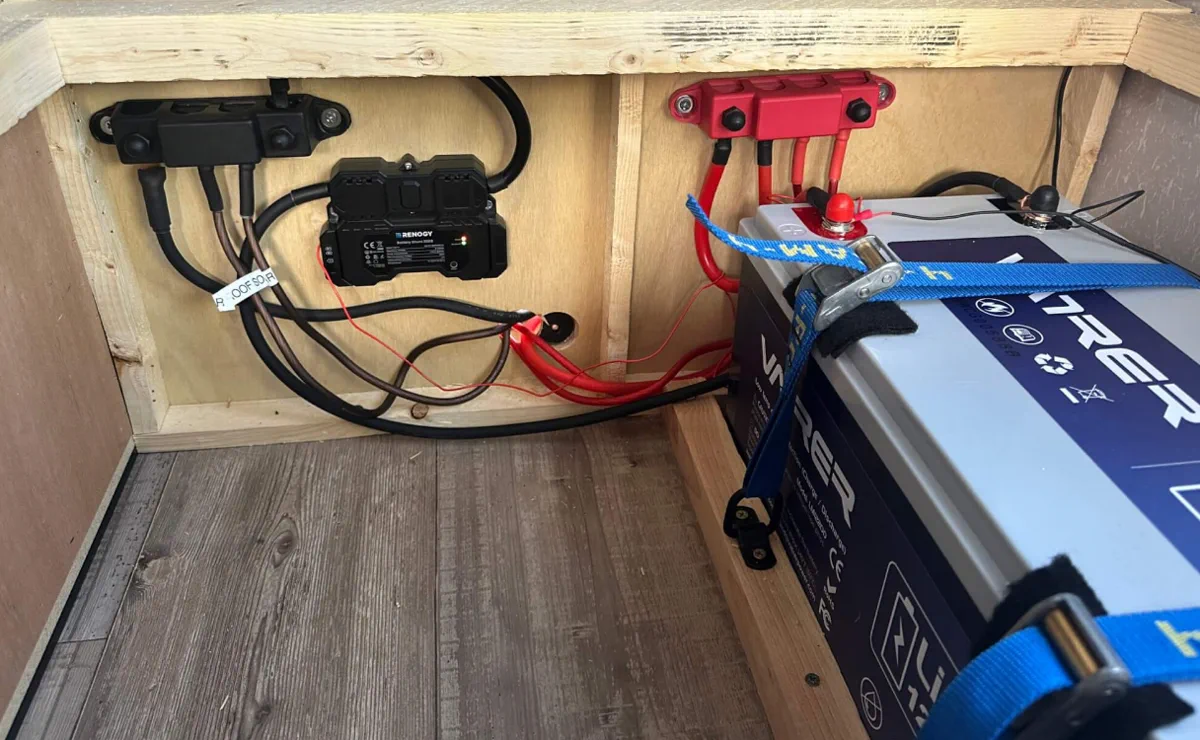
LiFePO4 cells discharge fine down to about minus 4 degrees but refuse to accept a charge below 25 degrees, and that hard chemistry limit is the single biggest cold-climate gotcha. Charging a frozen lithium cell plates the lithium and permanently damages capacity, which is why every quality BMS shuts off charge input below the threshold instead of letting the cell self-destruct.
The fix is one of three options. Buy a battery with internal BMS heating that draws 30 to 50W from the bank itself to warm cells before accepting charge, install an external silicone heat pad with a thermostat under the battery, or store the bank above the freeze line in a heated bay or basement compartment. Battle Born cold-weather technical guidance documents the same boundary across all of their LiFePO4 SKUs.
For owners in Boise, Coeur d'Alene, or Bozeman who actually use the rig in winter, internal heating is the cleanest answer because it works without owner attention. Snowbirds who store the rig and head south can skip heating since the bank will not be cycled until temperatures rise.
Lithium vs AGM vs flooded lead-acid: which is right for me?
Choose flooded lead-acid for a hookup-only weekender on a tight budget; AGM for a moderate boondocker who wants 4 to 6 years of trouble-free service; LiFePO4 for full-timers, hot-climate residential-fridge rigs, and anyone who has cycled through more than one lead-acid bank already. The cost gap is roughly 1x, 2x, and 6x at purchase, but the lifetime cost gap inverts hard once cycle life is factored in.
The table below shows realistic 2026 numbers for a 200Ah-equivalent house bank. Cycle life assumes typical RV use with no cell-balancing neglect or chronic over-discharge.
| Battery type | Cost | Cycle life (to 80%) | Weight | Cold-weather behavior | Usable depth | Charging speed | Payback period |
|---|---|---|---|---|---|---|---|
| Flooded lead-acid (2x 6V GC2) | $280 - $400 | 300-700 cycles | 130-150 lbs | Capacity drops 30% at 32°F; charges fine | 50% | Slow (8-12 hrs) | N/A (cheapest) |
| AGM (2x 12V Group 31) | $700 - $1,100 | 500-1,200 cycles | 140-160 lbs | Capacity drops 20% at 32°F; charges fine | 60% | Medium (6-8 hrs) | 3-5 yrs vs lead-acid |
| LiFePO4 standard (2x 100Ah) | $1,200 - $2,000 | 3,000-5,000 cycles | 60-80 lbs | No charge below 25°F (no heater) | 90-100% | Fast (1-3 hrs) | 3-6 yrs vs AGM |
| LiFePO4 with BMS heating (2x 100Ah) | $1,800 - $2,800 | 3,000-5,000 cycles | 70-90 lbs | Self-warms before charge accept | 90-100% | Fast (1-3 hrs) | 4-6 yrs vs AGM (cold climates) |
Usable depth is where the lifetime math really tips. A 200Ah lead-acid bank delivers 100Ah of usable energy before damage starts; a 200Ah LiFePO4 bank delivers 180 to 200Ah without harming the cells. NRVIA inspection standards flag chronic deep-discharge of lead-acid banks as a recurring cause of premature failure that lithium simply does not have.
Can I install lithium myself?
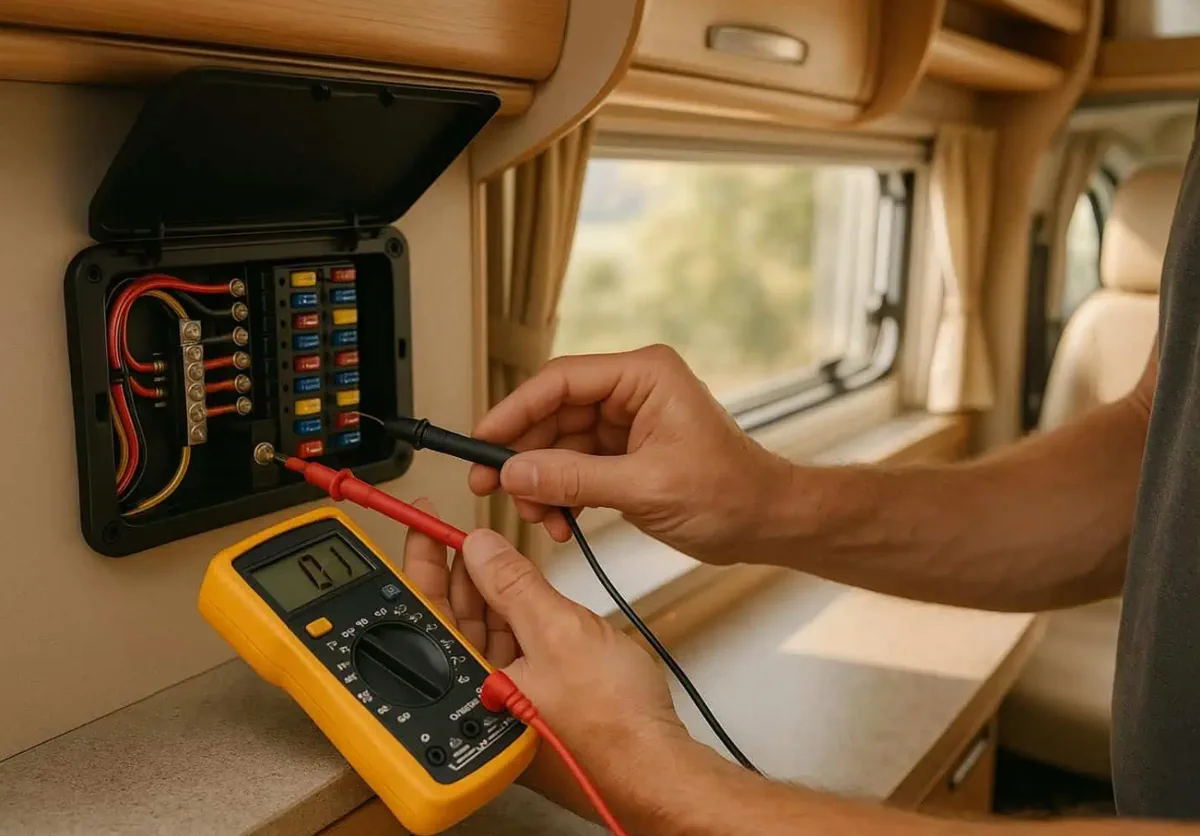
A drop-in single-battery swap on a coach with a lithium-ready converter is genuinely DIY-friendly: pull the old lead-acid, set the LiFePO4 in the same tray, reconnect the same cables, and update the monitor profile. Most owners can finish that work in 90 minutes with a wrench and a multimeter. The job stays simple as long as you are not changing bank size or amperage.
Multi-battery banks, 3,000W or larger inverter installs, alternator DC-DC chargers, and any rig still running an OEM lead-acid converter cross into pro territory. Cable sizing for a 4x100Ah bank running a 3,000W inverter requires 4/0 cable, proper crimping, and BMS coordination across batteries. Get any of that wrong and the BMS shuts the bank down on the first heavy load.
The other DIY trap is the converter. WFCO and stock Magnatek units made before 2022 will charge a LiFePO4 bank to about 80% and stop, because their absorption voltage targets lead-acid. Battery bank installation by an A1 RV Repair tech includes verifying the charger profile, which is where most DIY installs quietly fail.
Which lithium brand fits my RV?
Battle Born remains the safe default for North American RV installs because of its US-based warranty support and well-documented BMS behavior. Lithionics sits at the premium end with built-in heating and remote monitoring; Renogy and Epoch Essentials cover the value tier with similar cell quality at lower margins; SOK and Ampere Time round out the budget tier where you accept tighter warranty terms. Match the brand to how long you plan to keep the rig.
What matters more than brand is form factor and BMS spec. Group 24, Group 27, and Group 31 cases drop into existing trays without modification; oddly shaped server-rack batteries do not. The BMS continuous-discharge rating must equal or exceed your inverter's continuous draw, and the charge-current rating must support whatever your converter and solar can throw at it.
For full-timers in Houston or Fort Pierce running residential fridges and 3,000W inverters, a 400-600Ah bank with 200A continuous BMS rating per battery is the working spec. Cold-climate owners in Boise add internal heating and accept the small parasitic draw it costs.
Do I need a new charger, inverter, or battery monitor?
Most pre-2022 RV converters target a flooded lead-acid voltage curve and will leave a LiFePO4 bank chronically stuck at 80% state of charge. A lithium-ready converter or full inverter-charger is the single most important supporting upgrade, because without it the entire economic case for lithium evaporates. Plan on $250 to $1,800 depending on whether you choose a converter swap or a full inverter-charger.
The solar charge controller has the same problem. A controller without a LiFePO4 profile will undercharge the bank or float at the wrong voltage, both of which cut effective capacity. Most modern MPPT controllers from Victron, Renogy, and EPEver handle LiFePO4 natively, but anything older than 2020 deserves a profile audit before the new bank goes in.
Battery monitors are the third leg. Stock Magnatek voltage-only monitors read meaningless numbers on lithium because LiFePO4 voltage is essentially flat from 90% to 20%.
A shunt-based monitor like the Victron BMV-712 or SmartShunt reads true amp-hours in and out and is the difference between knowing your state of charge and guessing. Inverter and converter service usually handles this swap together with the bank install.
Can I mix lithium and lead-acid?
Mixing lithium and lead-acid in the same house bank is a hard no, even with a battery isolator between them. The two chemistries charge at different voltages, discharge along different curves, and trigger BMS shutoffs that the lead-acid side does not understand. The result is a bank that fights itself, with the lithium side either chronically undercharged or repeatedly tripping out under load.
What does work is keeping the chassis battery on lead-acid and the house bank on lithium, with a DC-DC charger between them. The DC-DC charger isolates the two systems, lets the engine alternator charge the chassis battery normally, and steps voltage and current up to the LiFePO4 absorption profile when the house bank is the target. Renogy DC-DC charger documentation walks through the same wiring pattern.
This is also the cleanest answer for owners doing a phased upgrade. Replace the house bank now, leave the chassis battery alone, and add the DC-DC charger as part of the install. The next time the chassis battery dies, replace it with another lead-acid because there is no benefit to lithium in a starter-battery role.
How long do lithium batteries last in real RV use?
A quality LiFePO4 RV bank delivers 3,000 to 5,000 charge cycles to 80% remaining capacity, which translates to roughly 8 to 15 calendar years for typical use. AGM banks deliver 500 to 1,200 cycles in the same conditions; flooded lead-acid lands at 300 to 700. Real-world lifespan tracks how often the bank dips below 20% state of charge, which is the deepest part of the cycle for any chemistry.
Calendar age also matters. Even a barely-cycled LiFePO4 bank degrades 1 to 2% per year from chemistry alone, so a 12-year-old battery sitting at 80% capacity is normal, not a defect. Lead-acid degrades faster on the calendar regardless of cycle count, especially in hot climates where bay temperatures push 110 degrees during summer storage.
For coaches that pair the lithium upgrade with RV solar, the bank typically sees less deep cycling because midday solar tops it back to 100% before the evening draw begins. Pair this with regular water pump health checks and the rest of the 12V system stays in sync. DOE lithium-ion battery research tracks the same calendar-degradation curve across automotive and stationary applications.